US-EU Trade Deal: Boosting Exports and Economic Growth by 12% by Q3 2026
Anúncios
In a landmark announcement that promises to reshape the global economic landscape, the United States and the European Union have unveiled a new trade agreement. This ambitious pact is projected to significantly boost exports by an impressive 12% by the third quarter of 2026. The US EU Trade Deal represents a pivotal moment for international commerce, signaling a renewed commitment to transatlantic cooperation and economic prosperity. This comprehensive agreement aims to dismantle existing trade barriers, foster innovation, and create a more predictable and stable environment for businesses on both sides of the Atlantic. The implications of this deal are far-reaching, touching upon various sectors, from agriculture and manufacturing to technology and services. Businesses, policymakers, and consumers alike are now keenly observing how this agreement will unfold and what tangible benefits it will deliver. The anticipated 12% increase in exports is not just a statistical projection; it represents thousands of new jobs, enhanced competitiveness, and a stronger global economic footing for both the US and the EU. This article delves into the intricacies of this historic agreement, exploring its potential impacts, the sectors poised for growth, and the broader geopolitical context in which it emerges. Understanding the nuances of this US EU Trade Deal is crucial for anyone involved in international trade or interested in global economic trends.
Anúncios
Understanding the Core of the New US EU Trade Deal
The recently announced US EU Trade Deal is not merely a superficial agreement but a deeply deliberated framework designed to address complex trade challenges and unlock new opportunities. At its core, the deal focuses on several key pillars: tariff reduction, regulatory harmonization, intellectual property protection, and enhanced cooperation in emerging technologies. By systematically tackling these areas, the agreement aims to streamline trade processes and reduce the costs associated with cross-border transactions. For instance, the reduction of tariffs on specific goods will make products from both regions more competitive in respective markets, directly contributing to the projected 12% increase in exports. Regulatory harmonization is another critical component, as differing standards and certifications often act as non-tariff barriers, impeding the free flow of goods and services. This deal seeks to align regulatory practices where feasible, making it easier for businesses to comply with requirements in both jurisdictions. Furthermore, robust provisions for intellectual property protection are expected to incentivize innovation and safeguard the creations of businesses and individuals, fostering a more dynamic and competitive environment. The emphasis on cooperation in emerging technologies, such as artificial intelligence and green energy, positions the US and EU at the forefront of future economic trends, ensuring that the trade relationship remains relevant and forward-looking. This multifaceted approach underscores the strategic importance of the US EU Trade Deal, laying the groundwork for sustained economic growth and deeper integration between two of the world’s largest economic blocs.
Key Provisions and Expected Benefits
The new US EU Trade Deal is replete with provisions designed to yield substantial benefits for both economies. One of the most eagerly anticipated outcomes is the significant reduction, and in some cases, elimination, of tariffs on a wide array of goods. This move is expected to immediately lower import costs for businesses and potentially translate into more affordable products for consumers. Beyond tariffs, the agreement introduces mechanisms for greater transparency and predictability in trade policies, which are essential for long-term investment planning. Businesses can now operate with a clearer understanding of the rules, reducing uncertainty and encouraging greater engagement in transatlantic trade. The deal also includes specific clauses aimed at facilitating trade for small and medium-sized enterprises (SMEs), recognizing their vital role in job creation and economic dynamism. By simplifying customs procedures and providing accessible information, the agreement seeks to empower smaller businesses to expand their reach into international markets, which was previously a daunting task. Another notable aspect is the commitment to sustainable trade practices, integrating environmental and labor standards into the agreement. This reflects a growing global recognition of the importance of responsible trade and aims to ensure that economic growth is achieved in an environmentally sound and socially equitable manner. These provisions collectively contribute to the ambitious target of a 12% export boost by Q3 2026, making the US EU Trade Deal a cornerstone of future economic strategy.
Sectors Poised for Significant Export Growth
The projected 12% increase in exports due to the US EU Trade Deal is not expected to be evenly distributed across all sectors. Rather, certain industries are particularly well-positioned to capitalize on the new opportunities presented by the agreement. Understanding which sectors will benefit most is crucial for businesses looking to adapt their strategies and maximize their gains. The manufacturing sector, for instance, is anticipated to see a considerable boost. With reduced tariffs on industrial goods and harmonized regulatory standards, manufacturers in both the US and EU can expect to see their products become more competitive in the opposing market. This could lead to increased production, investment in new technologies, and job creation. The automotive industry, in particular, often faces complex regulatory hurdles, and any simplification in this area could unlock significant trade volumes.
Anúncios
The agricultural sector is another key beneficiary of the US EU Trade Deal. Farmers and food producers have long faced a myriad of trade barriers, including quotas and sanitary and phytosanitary measures. While some sensitive areas may still require careful negotiation, the agreement aims to ease restrictions on a range of agricultural products, allowing for greater market access. This could mean more choices for consumers and new export markets for agricultural businesses. Furthermore, the technology and digital services sectors are expected to thrive under the new agreement. Provisions related to data flow, intellectual property, and digital trade are designed to support the growth of the digital economy, which is increasingly becoming a dominant force in global commerce. Companies specializing in software, cloud computing, e-commerce, and advanced manufacturing technologies will find it easier to offer their services and products across the Atlantic, fostering innovation and collaboration.
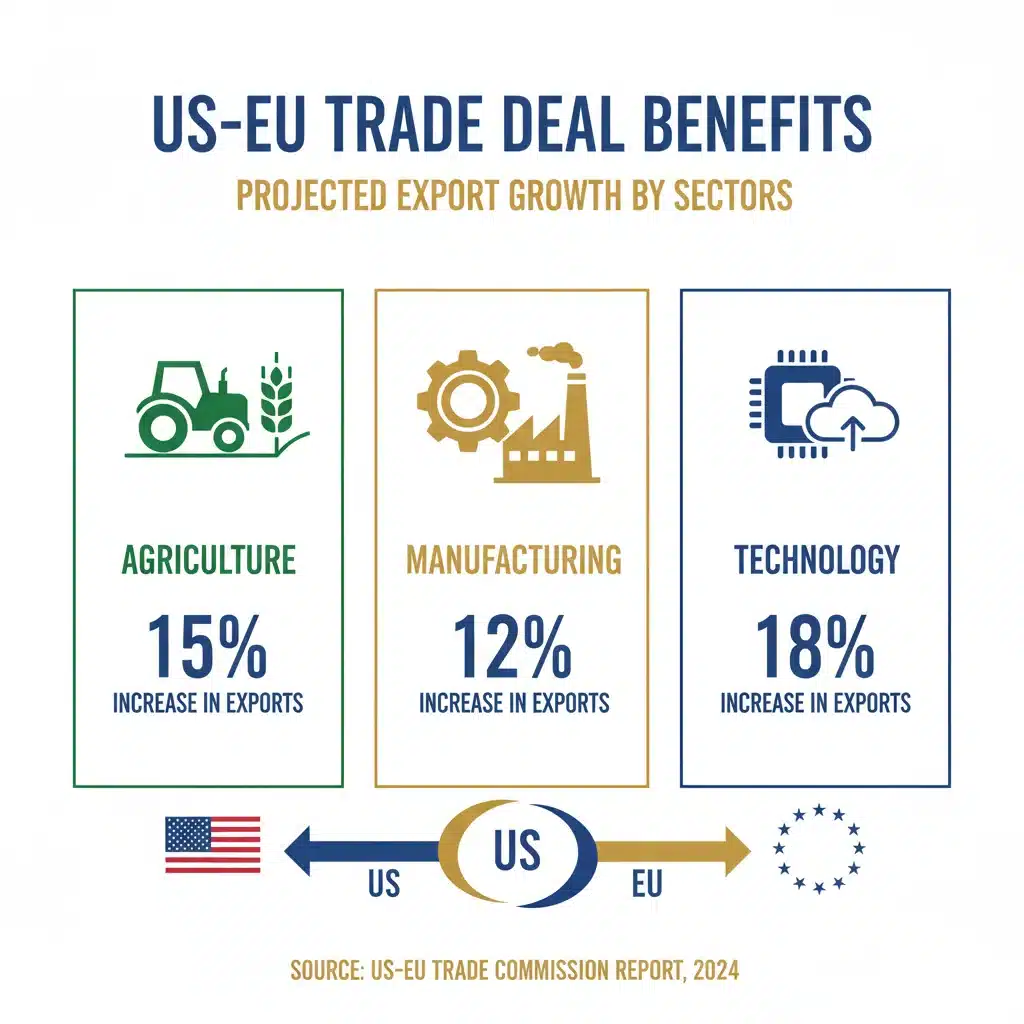
Beyond these major sectors, the services industry, including financial services, consulting, and tourism, is also set to benefit. The agreement’s focus on regulatory coherence and mutual recognition of professional qualifications can significantly reduce barriers for service providers looking to expand internationally. This broader impact across diverse industries underscores the comprehensive nature of the US EU Trade Deal and its potential to stimulate widespread economic activity. The emphasis on specific sectors suggests that businesses within these areas should proactively assess the new landscape and develop strategies to leverage the enhanced trade environment. The 12% export increase is not just an aggregate figure; it represents a mosaic of opportunities across various economic pillars, each contributing to the overall success of this ambitious transatlantic endeavor.
Economic Impact and Projections for Q3 2026
The economic ramifications of the new US EU Trade Deal are expected to be profound, culminating in the projected 12% surge in exports by Q3 2026. This growth forecast is based on detailed economic modeling that considers the removal of tariffs, reduction of non-tariff barriers, and increased market access. The immediate impact will likely be felt through a boost in trade volumes as businesses capitalize on the more favorable trading conditions. For the US, this could mean increased demand for American-made goods and services in the European market, leading to higher production levels and job creation in export-oriented industries. Similarly, European businesses will find it easier to penetrate the vast American market, leading to similar economic benefits across the EU member states.
Beyond direct trade, the agreement is expected to stimulate foreign direct investment (FDI). A more predictable and harmonized trade environment makes both the US and EU more attractive destinations for investment, as companies can have greater confidence in the stability of their supply chains and market access. This influx of FDI can lead to further job creation, technology transfer, and overall economic development. The enhanced competition resulting from reduced barriers is also anticipated to drive innovation and efficiency. Businesses will be incentivized to improve their products and processes to remain competitive in a larger, more integrated market. This dynamic environment can lead to better quality goods and services for consumers, as well as greater productivity across industries.
Moreover, the US EU Trade Deal is expected to bolster economic resilience. By diversifying supply chains and strengthening trade ties between two major economic powers, the agreement can help mitigate the risks associated with global economic shocks and geopolitical instability. A more interconnected and interdependent transatlantic economy is better equipped to withstand external pressures and maintain steady growth. The target of a 12% export increase by Q3 2026 is ambitious but achievable, given the comprehensive nature of the agreement and the sheer economic weight of the US and EU combined. This projection signals a period of robust economic expansion, driven by renewed trade cooperation and a shared vision for global prosperity. The coming years will be critical in observing how these projections translate into tangible benefits for businesses and citizens across the Atlantic.
Challenges and Opportunities in Implementation
While the US EU Trade Deal presents a wealth of opportunities, its successful implementation will undoubtedly face various challenges. One significant hurdle will be ensuring consistent application of the agreement’s provisions across all EU member states, each with its own regulatory nuances and economic priorities. Harmonizing standards and regulations, even with the best intentions, can be a complex and time-consuming process, requiring sustained political will and technical expertise. Stakeholders on both sides will need to actively engage to resolve any discrepancies and ensure a smooth transition to the new trade framework. Furthermore, domestic industries in both the US and EU may express concerns about increased competition. While the overall economic benefits are expected to outweigh these localized impacts, policymakers will need to address these concerns through support programs, retraining initiatives, and clear communication about the long-term advantages of the deal. The agreement’s success will also hinge on its ability to adapt to future economic shifts and technological advancements. The world of trade is constantly evolving, and the framework must be flexible enough to incorporate new challenges and opportunities that may arise before Q3 2026 and beyond. Regular reviews and mechanisms for dispute resolution will be crucial to maintaining the integrity and effectiveness of the agreement.

Despite these challenges, the opportunities presented by the US EU Trade Deal are immense. For businesses, it offers a chance to expand market reach, diversify customer bases, and optimize supply chains. Companies that proactively adapt to the new regulations and explore emerging markets within the transatlantic space will be best positioned to reap the rewards. For governments, the deal provides a platform for strengthening geopolitical alliances and promoting a rules-based international trading system. In an increasingly fragmented global environment, a strong US EU Trade Deal sends a powerful message about the benefits of cooperation and open markets. The agreement also opens doors for collaborative research and development, particularly in areas like green technologies and digital infrastructure. By pooling resources and expertise, the US and EU can accelerate innovation and address global challenges more effectively. Ultimately, the success of this deal will depend on the commitment of all parties to navigate the complexities, seize the opportunities, and work collaboratively towards the shared goal of enhanced economic prosperity and a robust transatlantic partnership. The path to a 12% export increase by Q3 2026 is ambitious, but with dedicated effort, it is well within reach.
Global Implications and Future Trade Relations
The new US EU Trade Deal extends its influence far beyond the immediate economic benefits for Washington and Brussels. Its global implications are significant, potentially reshaping trade relations and geopolitical dynamics worldwide. As two of the largest economic powers, a strengthened trade relationship between the US and EU sets a powerful precedent for international cooperation. This agreement can serve as a blueprint for future trade pacts, demonstrating how complex economies can find common ground to foster growth and stability. Other trading blocs and nations will be closely observing the outcomes, potentially influencing their own trade policies and strategic alliances. For instance, countries heavily reliant on trade with either the US or EU may need to reassess their strategies to remain competitive in a landscape increasingly defined by this powerful transatlantic partnership.
Moreover, the US EU Trade Deal could also influence multilateral trade negotiations. By demonstrating the effectiveness of bilateral and plurilateral agreements in addressing specific trade challenges, it might encourage a more pragmatic approach to global trade talks. This is particularly relevant in areas where consensus at the World Trade Organization (WTO) has been difficult to achieve, such as digital trade and environmental standards. The alignment of the US and EU on these issues could create a critical mass that eventually pushes for broader international norms. However, there is also the potential for trade diversion, where trade shifts from less efficient suppliers outside the US-EU bloc to more favored suppliers within it. While the goal is trade creation, policymakers will need to monitor these effects to ensure the deal contributes to overall global trade expansion rather than simply re-routing existing trade flows. The agreement also provides a counterbalance to the rising economic influence of other global powers, ensuring that Western democracies maintain a strong voice in shaping the future of international commerce. This strategic dimension of the US EU Trade Deal cannot be overstated, as it reinforces shared values and economic principles on a global stage. The success of this deal in achieving its 12% export target by Q3 2026 will therefore not only be a measure of its immediate economic impact but also a testament to its broader influence on the architecture of global trade and international relations for years to come.
Conclusion: A New Era for Transatlantic Trade
The announcement of the new US EU Trade Deal marks the dawn of a new era for transatlantic trade, promising a significant boost in exports by 12% by the third quarter of 2026. This comprehensive agreement, meticulously crafted to reduce tariffs, harmonize regulations, and foster innovation, is poised to inject substantial vitality into both the US and EU economies. From manufacturing and agriculture to technology and services, various sectors are set to benefit, creating a ripple effect of increased production, investment, and job creation. While challenges in implementation are inevitable, the shared commitment of both parties to overcome these hurdles underscores the strategic importance of this partnership.
The economic projections are robust, suggesting that the deal will not only facilitate direct trade growth but also stimulate foreign direct investment and enhance overall economic resilience. Globally, this agreement sends a powerful message about the enduring value of international cooperation and rules-based trade, potentially influencing future trade negotiations and geopolitical alignments. As businesses and policymakers navigate this evolving landscape, the focus will remain on maximizing the opportunities presented by the US EU Trade Deal to achieve sustainable growth and prosperity. The coming years will be a testament to the transformative power of this historic agreement, solidifying the economic ties between the United States and the European Union and setting a high benchmark for global trade relations. The 12% export increase by Q3 2026 is more than a target; it’s a vision for a stronger, more integrated, and more prosperous transatlantic economy.
Author