The 2026 U.S. Manufacturing Sector: A Deep Dive into Production Trends and a 4% Growth
The landscape of American industry is constantly evolving, driven by innovation, global dynamics, and strategic investments. As we look ahead to 2026, the US manufacturing outlook 2026 paints a promising picture, with projections indicating a robust 4% growth in the sector. This expansion is not merely a quantitative increase; it signifies a qualitative transformation, marked by technological integration, reshoring initiatives, and a renewed focus on sustainability. Understanding the intricacies of these trends is crucial for businesses, policymakers, and workers alike to navigate the future effectively.
The U.S. manufacturing sector, a cornerstone of the nation’s economic strength, has demonstrated remarkable resilience and adaptability in recent years. From the disruptions caused by global supply chain issues to the rapid acceleration of digital transformation, manufacturers have consistently innovated to meet new challenges. The anticipated 4% growth in 2026 is a testament to these efforts, reflecting a confluence of factors including government incentives, increased domestic demand, and a strategic pivot towards advanced manufacturing techniques.
This comprehensive article will delve into the various facets contributing to this optimistic US manufacturing outlook 2026. We will explore the key drivers behind the projected growth, analyze the impact of emerging technologies, examine the role of workforce development, and discuss potential challenges and opportunities that lie ahead. Our aim is to provide a detailed and insightful overview that sheds light on the future trajectory of American manufacturing.
Anúncios
Key Drivers Propelling the US Manufacturing Outlook 2026
Several fundamental forces are expected to catalyze the projected 4% growth in the US manufacturing outlook 2026. These drivers are interconnected, creating a synergistic effect that reinforces the sector’s positive trajectory.
1. Government Initiatives and Policy Support
Federal and state governments are playing an increasingly active role in bolstering domestic manufacturing. Legislation such as the CHIPS and Science Act and the Inflation Reduction Act provides significant incentives for companies to invest in U.S.-based production, particularly in critical sectors like semiconductors, clean energy, and advanced materials. These policies offer tax credits, grants, and funding for research and development, directly stimulating investment and job creation. The long-term impact of these initiatives is expected to be a more resilient and competitive manufacturing base, contributing substantially to the positive US manufacturing outlook 2026.
Anúncios
2. Reshoring and Nearshoring Trends
The vulnerabilities exposed by global supply chain disruptions during the pandemic have accelerated the trend of reshoring and nearshoring manufacturing operations. Companies are increasingly recognizing the benefits of geographical proximity to end markets, reduced lead times, and greater control over quality and intellectual property. This strategic shift is bringing production back to American soil or to nearby countries, directly boosting domestic output and contributing to the robust US manufacturing outlook 2026. This trend is not just about bringing jobs back, but also about building more robust and secure supply chains for the future.
3. Technological Advancements and Automation
The integration of advanced technologies such as artificial intelligence (AI), machine learning (ML), the Internet of Things (IoT), and robotics is fundamentally transforming manufacturing processes. These technologies enhance efficiency, reduce costs, improve product quality, and enable greater customization. Smart factories, powered by interconnected systems, are becoming more prevalent, optimizing production flows and predictive maintenance. The continuous adoption and innovation in these areas are pivotal to maintaining a competitive edge and are a major contributor to the optimistic US manufacturing outlook 2026.
4. Growing Domestic Demand and Consumer Confidence
A healthy domestic economy with strong consumer spending is a primary driver for manufacturing output. As consumer confidence remains stable or grows, demand for a wide range of goods, from automotive to electronics and consumer packaged goods, increases. This sustained demand provides a solid foundation for manufacturers to expand production and invest in new capacities. Furthermore, a growing population and evolving consumer preferences for domestically produced goods also contribute positively to the US manufacturing outlook 2026.
5. Sustainable Manufacturing Practices
There’s a growing emphasis on sustainable and environmentally friendly manufacturing processes. Companies are investing in renewable energy sources, waste reduction, and circular economy principles, not only to meet regulatory requirements but also to appeal to environmentally conscious consumers and investors. This focus on sustainability is driving innovation in materials, production methods, and supply chain management, creating new opportunities and contributing to the overall growth and resilience of the US manufacturing outlook 2026.
Sector-Specific Projections and Growth Areas
While the overall US manufacturing outlook 2026 is positive, certain sectors are expected to experience particularly strong growth. Understanding these nuances is essential for targeted investments and strategic planning.
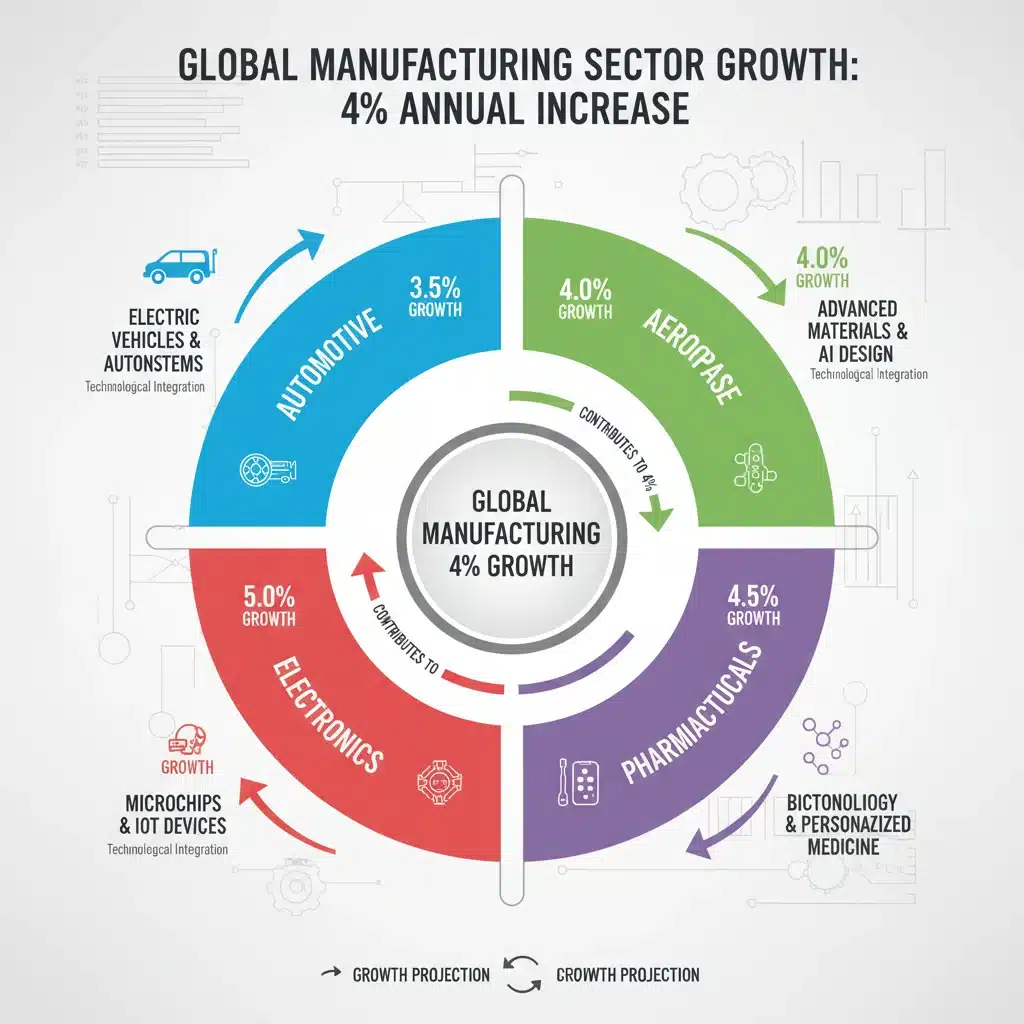
1. Advanced Electronics and Semiconductors
Fueled by the CHIPS and Science Act, the semiconductor industry is undergoing a massive resurgence in the U.S. Significant investments are being made in new fabrication plants (fabs) and research facilities. This sector is critical for virtually all modern technologies, from AI to telecommunications, and its domestic expansion is a strategic priority. The growth in advanced electronics will have a ripple effect across other industries, solidifying its position as a key driver for the US manufacturing outlook 2026.
2. Electric Vehicles (EVs) and Battery Manufacturing
The transition to electric vehicles is accelerating, with major automakers investing heavily in U.S.-based EV production and battery manufacturing facilities. Government incentives and consumer demand for sustainable transportation are propelling this sector forward. The entire supply chain for EVs, from raw materials processing to final assembly, is expanding, creating numerous manufacturing jobs and contributing significantly to the projected 4% growth in the US manufacturing outlook 2026.
3. Renewable Energy Equipment
The push for clean energy, supported by policies like the Inflation Reduction Act, is boosting demand for solar panels, wind turbine components, and other renewable energy technologies. U.S. manufacturers are expanding their capacities to produce these essential components, reducing reliance on foreign supply chains and creating a robust domestic industry. This sector is not only a source of economic growth but also a critical component of the nation’s energy independence and environmental goals, further strengthening the US manufacturing outlook 2026.
4. Pharmaceuticals and Medical Devices
The healthcare sector remains a resilient and growing market. The lessons learned from the pandemic have underscored the importance of domestic production of essential medicines, vaccines, and medical devices. Investments in biomanufacturing and advanced medical technology production are expected to continue, driven by an aging population, ongoing research and development, and a focus on supply chain security. This steady growth contributes consistently to the overall positive US manufacturing outlook 2026.
5. Aerospace and Defense
With ongoing global geopolitical complexities and continuous innovation in aerospace technology, the defense and commercial aerospace sectors are expected to maintain strong performance. Government contracts for defense equipment and a rebound in commercial air travel will drive demand for aircraft, components, and related technologies. This high-value manufacturing sector remains a significant contributor to the US manufacturing outlook 2026.
The Role of Technology in Shaping the 2026 US Manufacturing Outlook
Technology is not just a driver of growth; it is a transformative force reshaping every aspect of manufacturing. The 2026 landscape will be characterized by an even deeper integration of digital tools and advanced automation.
1. Artificial Intelligence and Machine Learning (AI/ML)
AI and ML are revolutionizing manufacturing processes by enabling predictive maintenance, optimizing production schedules, improving quality control through automated inspection, and enhancing supply chain visibility. These technologies allow manufacturers to make data-driven decisions, reduce downtime, and achieve higher levels of efficiency and product consistency. The ability of AI to analyze vast datasets and identify patterns will be crucial for competitive advantage in the US manufacturing outlook 2026.
2. Internet of Things (IoT) and Industrial IoT (IIoT)
The proliferation of IoT sensors and connected devices on factory floors creates a wealth of real-time data. This data can be used to monitor equipment performance, track inventory, manage energy consumption, and optimize environmental conditions. IIoT platforms facilitate communication between machines, enabling autonomous operations and self-optimizing systems, which are central to the smart factory concept and crucial for realizing the full potential of the US manufacturing outlook 2026.
3. Robotics and Advanced Automation
Beyond traditional industrial robots, collaborative robots (cobots) are becoming more common, working alongside human employees to perform repetitive or hazardous tasks. Advanced automation extends to automated material handling, assembly, and packaging, significantly increasing throughput and reducing labor costs. The continuous evolution of robotics will play a vital role in addressing labor shortages and boosting productivity, thereby supporting the positive US manufacturing outlook 2026.
4. Additive Manufacturing (3D Printing)
Additive manufacturing continues to evolve beyond prototyping, becoming a viable method for producing end-use parts, especially for complex geometries and customized products. It offers benefits in terms of design flexibility, reduced material waste, and localized production, which aligns perfectly with reshoring initiatives. As materials and processes advance, 3D printing will increasingly contribute to the agility and innovation within the US manufacturing outlook 2026.
5. Digital Twins and Simulation
Digital twin technology creates virtual replicas of physical assets, processes, or systems, allowing manufacturers to simulate scenarios, test changes, and predict outcomes without disrupting actual production. This capability enhances design, optimizes operations, and facilitates proactive problem-solving, leading to significant cost savings and efficiency gains. Digital twins will be instrumental in optimizing complex manufacturing environments as part of the US manufacturing outlook 2026.

Workforce Development and the Future of Manufacturing Jobs
The technological transformation of the US manufacturing outlook 2026 necessitates a corresponding evolution in the workforce. The nature of manufacturing jobs is shifting, requiring new skills and training programs.
1. Bridging the Skills Gap
The demand for workers with STEM (Science, Technology, Engineering, and Mathematics) skills is growing rapidly. Manufacturers need employees who can operate and maintain advanced machinery, analyze data, and work with complex software. Addressing this skills gap is paramount for sustained growth. Educational institutions, industry associations, and government programs are collaborating to develop curricula and apprenticeships that equip workers with the necessary competencies for the jobs of tomorrow.
2. Upskilling and Reskilling Initiatives
Existing workforces will require continuous upskilling and reskilling to adapt to new technologies and processes. Companies are investing in internal training programs and partnering with vocational schools to ensure their employees remain competitive and proficient. A flexible and adaptable workforce is key to leveraging the benefits of automation and maintaining productivity in the evolving US manufacturing outlook 2026.
3. Attracting New Talent
Manufacturing needs to attract a new generation of talent. By showcasing the innovative, high-tech, and sustainable aspects of modern manufacturing, the sector can appeal to younger workers. Emphasizing career growth opportunities, competitive wages, and the chance to work with cutting-edge technologies will be crucial in drawing individuals into the manufacturing field, supporting the long-term positive US manufacturing outlook 2026.
4. Human-Robot Collaboration
The future of manufacturing is not about robots replacing humans entirely, but rather about effective human-robot collaboration. Cobots can handle strenuous or repetitive tasks, freeing up human workers to focus on more complex problem-solving, oversight, and creative tasks. This synergy enhances productivity and improves workplace safety, creating more fulfilling roles within the manufacturing environment.
Challenges and Considerations for the 2026 US Manufacturing Outlook
While the US manufacturing outlook 2026 is largely positive, several challenges need to be addressed to ensure sustained and equitable growth.
1. Supply Chain Resilience
Despite reshoring efforts, global supply chains remain complex and vulnerable to disruptions. Geopolitical events, natural disasters, and trade disputes can still impact the availability of raw materials and components. Manufacturers must continue to diversify their supply bases, implement advanced risk management strategies, and invest in supply chain visibility tools to mitigate these risks.
2. Cybersecurity Threats
As manufacturing becomes more digitized and interconnected, the risk of cyberattacks increases. Operational technology (OT) systems are increasingly targeted, potentially leading to production shutdowns, data breaches, and intellectual property theft. Robust cybersecurity measures, employee training, and continuous monitoring are essential to protect critical infrastructure and maintain operational integrity within the US manufacturing outlook 2026.
3. Inflationary Pressures and Economic Volatility
Inflationary pressures on raw materials, energy, and labor costs can impact manufacturers’ profitability and pricing strategies. Economic volatility, including potential recessions or shifts in consumer spending, also poses a risk. Manufacturers must maintain financial agility, optimize cost structures, and innovate to offer value in a dynamic economic environment.
4. Regulatory Landscape
An evolving regulatory landscape, particularly concerning environmental standards, trade policies, and labor laws, can create compliance challenges and increased operational costs. Manufacturers need to stay abreast of these changes and adapt their strategies accordingly to avoid penalties and maintain social license to operate.
5. Global Competition
Despite domestic growth, U.S. manufacturers operate in a highly competitive global market. Countries with lower labor costs or different regulatory environments can pose significant competition. Continuous innovation, investment in advanced technologies, and a focus on high-value products are crucial for maintaining a competitive edge and ensuring the long-term health of the US manufacturing outlook 2026.
Conclusion: A Bright Future for US Manufacturing
The 2026 U.S. manufacturing sector is on the cusp of an exciting era of growth and innovation. The projected 4% expansion is a testament to the industry’s adaptability, the effectiveness of strategic government policies, and the relentless pursuit of technological advancement. From the resurgence of semiconductor production to the rapid growth in EV manufacturing and renewable energy technologies, American industry is diversifying and strengthening its core.
While challenges such as supply chain resilience, cybersecurity, and workforce development remain, the proactive measures being taken across the sector are positioning it for sustained success. The integration of AI, IoT, robotics, and other advanced technologies is not just enhancing efficiency but also creating new types of jobs and fostering a more dynamic and intelligent manufacturing ecosystem.
For businesses, investing in digital transformation, sustainable practices, and workforce training will be paramount. For policymakers, continued support through favorable legislation and infrastructure development will be crucial. And for the American workforce, opportunities abound in a sector that is increasingly high-tech, innovative, and essential to the nation’s economic prosperity and security.
The US manufacturing outlook 2026 is not just about numbers; it’s about building a stronger, more resilient, and more technologically advanced industrial future for the United States. The foundations are being laid today for a vibrant and competitive manufacturing sector that will continue to drive economic growth and global leadership for years to come.