
Credentialing for Success: How US Professionals Can Earn a New Certification in Under 6 Months for Career Boost
In today’s fast-evolving job market, especially within the United States, staying competitive and relevant is more crucial than ever. For many professionals, this means continuously enhancing their skill sets and validating their expertise through formal recognition. One of the most effective and time-efficient ways to achieve this is by earning a new professional certification. But what if you could achieve a significant career certification boost in under six months? This article will delve into the strategic approach US professionals can adopt to rapidly acquire valuable credentials, paving the way for accelerated career growth, increased earning potential, and expanded opportunities.
The landscape of professional development is constantly shifting. What was considered cutting-edge five years ago might now be standard, and entirely new fields and technologies emerge with startling regularity. In this dynamic environment, a university degree, while foundational, often isn’t enough to keep pace. Certifications, on the other hand, offer a targeted, often industry-specific, and frequently faster route to demonstrating proficiency in high-demand areas. They signal to employers that you possess up-to-date knowledge and practical skills, making you a more attractive candidate for promotions, new roles, and higher salaries. This immediate value proposition makes pursuing a career certification boost an incredibly smart move for any ambitious professional.
Many professionals shy away from pursuing new certifications, fearing the time commitment and financial investment. However, with careful planning and a focused strategy, earning a significant credential in six months or less is not just a pipe dream; it’s an achievable goal. This guide will break down the process into actionable steps, from identifying the right certification to optimizing your study habits and leveraging your new credential for maximum career impact. We’ll explore how to navigate the vast array of options available to US professionals, ensuring your effort translates into a tangible career certification boost.
Anúncios
Why a Rapid Career Certification Boost Matters in the US Market
The US job market is characterized by its competitiveness and rapid technological advancements. Companies are constantly seeking individuals who can bring immediate value and adapt to new challenges. This is where a targeted career certification boost becomes invaluable. Unlike traditional academic degrees, which often provide broad theoretical knowledge, certifications are designed to validate specific skill sets that are directly applicable to current industry needs. This direct relevance is a major reason why employers increasingly view certifications as critical indicators of a candidate’s readiness and capability.
Consider the tech sector, for instance. Cloud computing, cybersecurity, and data science are fields where certifications from providers like AWS, CompTIA, or Google are often considered prerequisites or strong advantages for employment. Similarly, in project management, the PMP (Project Management Professional) certification is globally recognized and can significantly enhance a professional’s career trajectory and earning potential. Even in more traditional fields like healthcare or finance, specialized certifications can differentiate you from peers and open doors to advanced roles.
Anúncios
A quick career certification boost within a six-month timeframe offers several compelling advantages:
- Enhanced Employability: Certifications demonstrate a commitment to continuous learning and a proactive approach to skill development, making you more attractive to potential employers.
- Increased Earning Potential: Studies consistently show that certified professionals often command higher salaries than their non-certified counterparts in similar roles.
- Skill Validation: Certifications provide objective proof of your expertise, building credibility and trust with colleagues and clients.
- Career Advancement: Many certifications are designed for specific career paths, acting as stepping stones to promotions or leadership roles.
- Networking Opportunities: Pursuing certifications often connects you with a community of like-minded professionals, expanding your professional network.
- Adaptability: Rapidly acquiring new certifications allows you to quickly pivot or specialize in emerging areas, ensuring your skills remain relevant in a dynamic market.
The key is to approach this strategically, focusing on certifications that align with your career goals and offer the highest return on investment in the shortest possible time. This targeted approach is fundamental to achieving a meaningful career certification boost without extensive time commitments.
Step 1: Identifying the Right Certification for Your Career Certification Boost
The first and arguably most critical step in earning a new certification quickly is choosing the right one. With thousands of certifications available, a haphazard approach will only lead to wasted time and resources. Your selection should be driven by your career aspirations, current industry trends, and the demand within the US job market.
A. Self-Assessment: What Are Your Goals?
Before looking outwards, look inwards. Ask yourself:
- What are my long-term career goals? Do I want to advance in my current field, or make a career transition?
- What skills do I currently possess, and what gaps do I need to fill to reach my goals?
- What aspects of my work do I genuinely enjoy and want to specialize in?
- What kind of roles or industries excite me most?
Understanding your motivations and desired outcomes will narrow down the vast field of options and help you pinpoint certifications that genuinely contribute to your desired career certification boost.
B. Market Research: What’s in Demand?
Once you have a clear idea of your internal compass, it’s time to survey the external landscape:
- Job Boards: Browse popular US job boards (LinkedIn, Indeed, Glassdoor, etc.) for roles you aspire to. Pay close attention to the ‘preferred qualifications’ or ‘required certifications’ sections. This will give you direct insight into what employers are looking for.
- Industry Reports: Consult reports from reputable organizations like Gartner, Forrester, or industry-specific associations. These often highlight emerging skill gaps and in-demand certifications.
- Professional Networks: Talk to colleagues, mentors, and recruiters in your field. Ask them which certifications they value, which ones have helped their careers, and which ones are gaining traction.
- Competitor Analysis: Look at the profiles of professionals in roles you admire. What certifications do they hold? This can provide valuable clues for your own career certification boost.
- Certification Body Websites: Explore the websites of major certification providers (e.g., PMI, Cisco, Microsoft, Google, AWS, SHRM, ISC2). They often provide career path guides and highlight the benefits of their credentials.
C. Feasibility Check: Can You Do It in Under 6 Months?
This is where the ‘under 6 months’ constraint becomes crucial. Not all certifications are designed for rapid acquisition. Consider:
- Prerequisites: Do you meet the experience or educational prerequisites for the certification? Some, like the PMP, require significant prior experience.
- Exam Difficulty and Format: Research the exam structure, content, and typical pass rates. Some exams are notoriously difficult and require extensive preparation.
- Study Material Availability: Is there abundant, high-quality study material (courses, books, practice exams) readily available?
- Time Commitment: Estimate the total study hours required. For a six-month timeline, you’ll need to realistically assess how many hours per week you can dedicate. For example, if a certification typically requires 150-200 hours of study, that’s roughly 6-8 hours per week, which is very manageable for most working professionals.
By diligently following these steps, you can confidently select a certification that is both impactful for your career certification boost and realistically achievable within your desired timeframe.

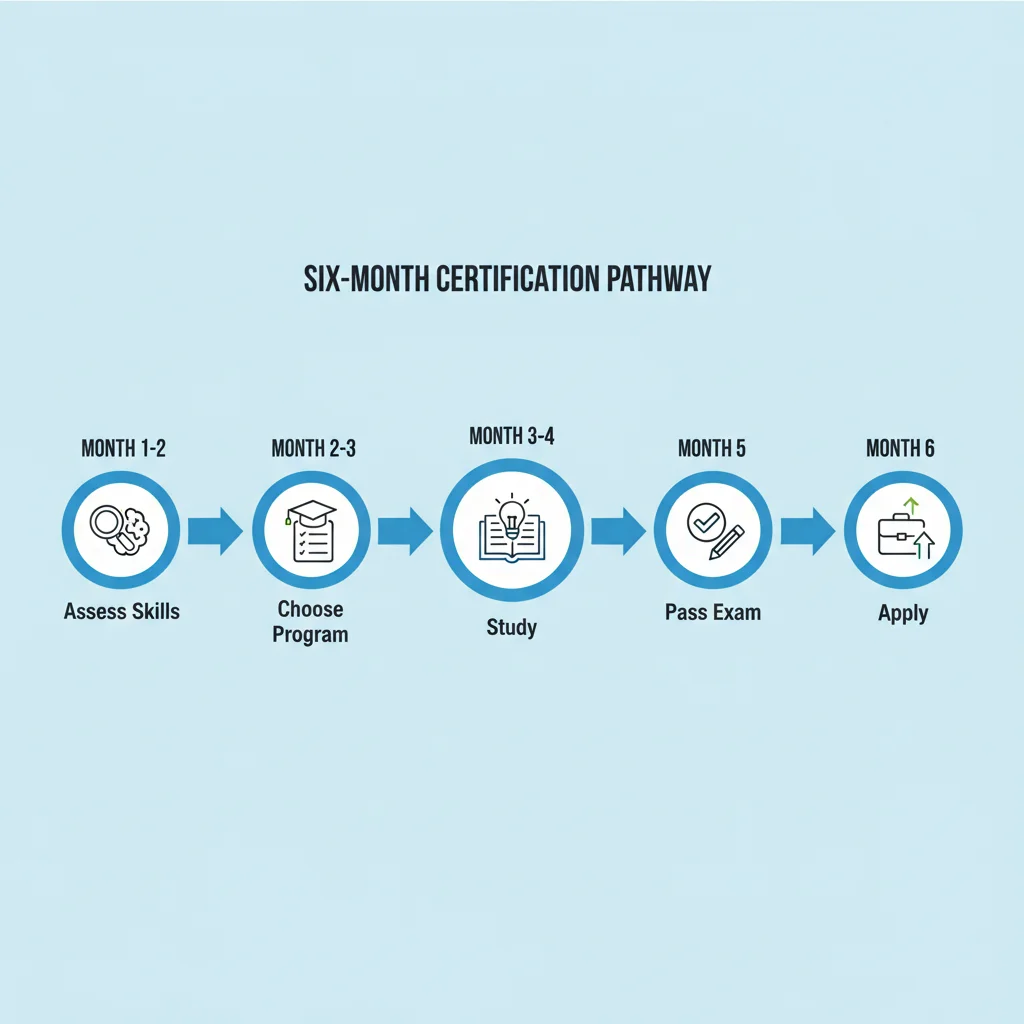
Step 2: Crafting Your Six-Month Study Plan for a Career Certification Boost
Once you’ve identified your target certification, the next step is to create a structured and realistic study plan. A well-defined plan is the backbone of achieving your career certification boost within the six-month window.
A. Break Down the Curriculum
Most certification bodies provide an outline of the exam content, often referred to as an ‘exam blueprint’ or ‘candidate handbook.’ This document is your most valuable resource. Break down the entire curriculum into smaller, manageable modules or topics. Assign estimated study times to each section based on its weight in the exam and your current familiarity with the subject matter.
B. Set Milestones and Deadlines
Divide your six-month timeline into smaller chunks (e.g., monthly, bi-weekly). For each period, set specific, achievable study goals. For example, ‘By the end of month 1, I will have completed Modules 1-3 and taken a practice quiz.’ This creates a sense of progress and helps you stay on track for your career certification boost.
C. Choose Your Study Resources Wisely
The quality of your study materials can significantly impact your efficiency. Look for a combination of resources:
- Official Study Guides: Often published by the certification body, these are usually the most authoritative.
- Online Courses: Platforms like Coursera, Udemy, edX, or specific vendor-led training (e.g., AWS Training, Microsoft Learn) offer structured learning paths. Look for courses that align directly with the exam objectives.
- Practice Exams: Essential for familiarizing yourself with the exam format, question types, and identifying areas for improvement. Investing in high-quality practice exams is crucial.
- Flashcards/Quiz Apps: Great for memorizing key terms, concepts, and formulas.
- Study Groups/Forums: Collaborating with others can provide different perspectives, clarify doubts, and offer motivation.
Prioritize resources that are known for their effectiveness in preparing candidates for your specific certification, ensuring a streamlined path to your career certification boost.
D. Schedule Dedicated Study Time
Consistency is more important than cramming. Block out specific times in your calendar each week for studying. Treat these appointments with the same importance as work meetings. Even 1-2 hours daily can add up significantly over six months. Identify your peak productivity times and schedule your most challenging study tasks then.
E. Incorporate Active Learning Techniques
Passive reading is often ineffective. Engage with the material actively:
- Summarize: After reading a section, try to summarize it in your own words.
- Teach: Explain concepts to an imaginary student or a study partner.
- Practice: Work through practice problems, scenarios, and labs.
- Flashcards: Use them regularly to test your recall.
- Mind Maps: Visualizing connections between concepts can aid understanding and retention.
These techniques will ensure that the knowledge you gain contributes effectively to your desired career certification boost.
Step 3: Optimizing Your Study Habits and Overcoming Challenges
Even with a solid plan, maintaining momentum and overcoming obstacles are key to a successful six-month certification journey. Effective study habits and resilience are crucial for your career certification boost.
A. Time Management and Focus
- Pomodoro Technique: Work in focused 25-minute intervals, followed by short breaks. This can improve concentration and prevent burnout.
- Eliminate Distractions: Turn off notifications, close unnecessary tabs, and find a quiet study environment.
- Prioritize: On busy days, identify the most critical study tasks and focus on those.
B. Leverage Technology
Utilize apps and tools that support your learning:
- Note-taking Apps: OneNote, Evernote, or Notion can help organize your study materials.
- Flashcard Apps: Anki or Quizlet are excellent for spaced repetition.
- Productivity Apps: Tools like Todoist or Trello can help manage your study schedule.
C. Stay Healthy and Prevent Burnout
A six-month sprint requires sustained energy. Don’t neglect your well-being:
- Sleep: Adequate sleep is vital for memory consolidation and cognitive function.
- Nutrition: Eat balanced meals to maintain energy levels.
- Exercise: Physical activity can reduce stress and improve focus.
- Breaks: Schedule regular short breaks and longer breaks to recharge. Don’t study for hours on end without a mental reset.
Burnout is a real threat to your career certification boost efforts. Recognize the signs and take proactive steps to prevent it.
D. Practice, Practice, Practice
As you get closer to the exam, shift your focus heavily towards practice questions and full-length mock exams. This will:
- Familiarize you with the exam environment and time constraints.
- Help you identify weak areas that need further review.
- Build confidence and reduce test anxiety.
Review every practice question, even the ones you got right, to understand the reasoning behind the correct answer and why other options were incorrect. This deep understanding is crucial for a successful career certification boost.
E. Address Weaknesses Proactively
Don’t ignore topics you find difficult. Dedicate extra time to these areas. Seek clarification from online forums, study groups, or additional resources. Acknowledging and conquering your weaknesses is a hallmark of effective preparation for any significant career certification boost.
Step 4: Acing the Exam and Leveraging Your New Credential for a Career Certification Boost
The final hurdle is the exam itself. While preparation is paramount, strategic execution on exam day and effective post-certification actions are equally important for maximizing your career certification boost.
A. Exam Day Strategies
- Get Good Rest: Ensure you are well-rested the night before.
- Eat a Healthy Meal: Avoid heavy or sugary foods that can lead to a crash.
- Arrive Early: Give yourself ample time to reach the test center, settle in, and avoid last-minute stress.
- Read Questions Carefully: Don’t rush. Understand what each question is truly asking.
- Time Management: Keep an eye on the clock. If you’re stuck on a question, mark it for review and move on.
- Trust Your Gut: Often, your first instinct is correct. Avoid overthinking unless you have a strong reason to change an answer.
These simple strategies can significantly improve your performance and ensure your hard work culminates in a successful career certification boost.
B. Updating Your Professional Profile
As soon as you pass, make sure to update all your professional platforms:
- LinkedIn: Add the certification to your ‘Licenses & Certifications’ section. Consider writing a post about your achievement, highlighting what you learned and how it will benefit your work.
- Resume/CV: Prominently display your new certification, especially in a dedicated ‘Certifications’ section or next to your name if it’s highly relevant.
- Email Signature: For highly relevant certifications, consider adding it to your email signature.
- Personal Website/Portfolio: If you maintain these, ensure they reflect your new credential.
Publicizing your achievement is a critical component of leveraging your career certification boost. It ensures that your network and potential employers are aware of your enhanced capabilities.
C. Communicating Your Achievement to Your Employer
Don’t wait for your annual review. Schedule a meeting with your manager to discuss your new certification. Explain:
- What the certification entails.
- How the skills you’ve gained can directly benefit your team and the company.
- Your interest in taking on new responsibilities or projects that leverage your new expertise.
This proactive approach can lead to new opportunities, promotions, or even a salary increase, directly translating your efforts into a tangible career certification boost within your current organization.
D. Networking and Mentorship
Your new certification opens doors to new professional communities. Join relevant industry associations, attend webinars, and participate in online forums. Seek out mentors who have advanced in your newly certified area. Networking is a powerful tool for converting your credential into a sustained career certification boost.
E. Continuous Learning
Remember that certifications often have continuing education requirements. Plan to maintain your credential and stay updated on the latest developments in your field. The journey of professional development is continuous, and your initial career certification boost is just one step in a lifelong commitment to learning.
Real-World Examples of Rapid Career Certification Boosts
To illustrate the power of this approach, let’s consider a few hypothetical, yet common, scenarios for US professionals:
Scenario 1: The IT Professional Seeking Specialization
Sarah, an experienced IT support specialist, wanted to move into cloud architecture. She identified the AWS Certified Solutions Architect – Associate as a high-demand certification. She dedicated 1.5 hours per weekday evenings and 4 hours on Saturdays for 5 months, using an online course, official practice exams, and a study group. Within 5.5 months, she passed the exam, updated her LinkedIn, and within two months, was promoted to a Cloud Engineer role within her company, experiencing a significant career certification boost.
Scenario 2: The Marketing Professional Embracing Digital
David, a traditional marketing manager, recognized the shift towards digital. He targeted the Google Ads Search Certification and Google Analytics Individual Qualification (GAIQ). These are shorter, more focused certifications. He spent about 1 hour daily for 3 months, utilizing Google’s free learning paths and practice tests. He earned both, and his enhanced digital marketing skills led to him leading several new online campaigns, showcasing a clear career certification boost.
Scenario 3: The Project Coordinator Aiming for Leadership
Maria, a project coordinator, aspired to become a project manager. She knew the CAPM (Certified Associate in Project Management) was a stepping stone to the PMP, but she wanted a quicker, more direct route to a significant career certification boost. After gaining the necessary experience, she focused on the PMP. She enrolled in an intensive 5-day bootcamp (which provided the required contact hours), followed by 3 months of rigorous self-study (10-15 hours/week) using a PMP exam simulator. She passed on her first attempt, and within 4 months, was managing larger projects and interviewing for Project Manager roles, achieving a substantial career certification boost.
These examples highlight that with focus, a clear plan, and consistent effort, a significant career certification boost in under six months is not only possible but can lead to transformative professional outcomes.
Conclusion: Your Path to a Rapid Career Certification Boost
Earning a new professional certification in under six months is an ambitious yet entirely achievable goal for US professionals seeking a rapid career certification boost. It requires a strategic approach, starting with a clear understanding of your career objectives and thorough market research to identify the most impactful credential. Once chosen, a disciplined study plan, effective time management, and a commitment to active learning will be your greatest allies.
The benefits of such an endeavor are profound: enhanced employability, increased earning potential, validated expertise, and accelerated career advancement. In a job market that values agility and up-to-date skills, demonstrating your proactive commitment to professional development through a timely certification can set you apart and open doors to opportunities you might not have otherwise accessed.
Don’t let the perceived challenge deter you. Break down the process, leverage available resources, stay consistent, and believe in your ability to succeed. Your next big career move, fueled by a strategic career certification boost, could be just around the corner. Start planning today, and take control of your professional future.