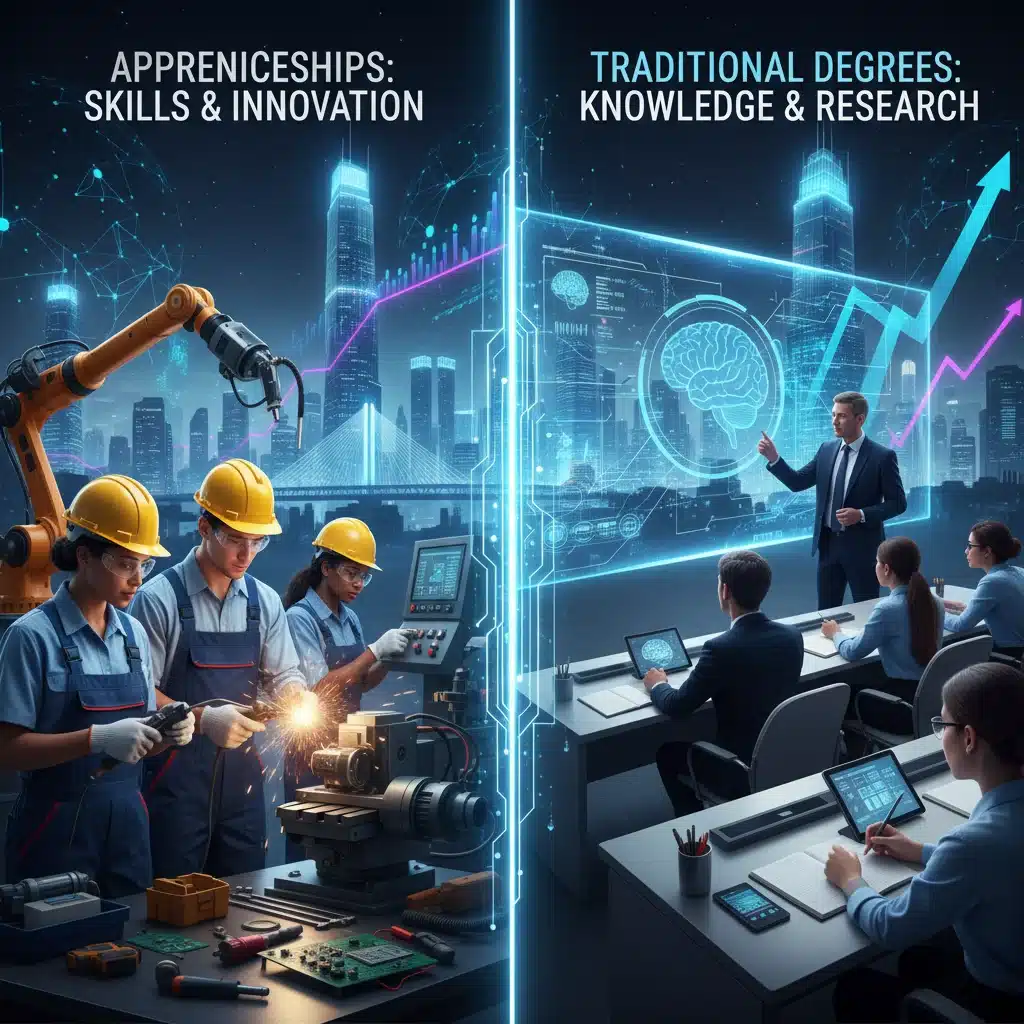
Apprenticeships vs. Degrees: Which Path Offers Faster Career Advancement in the US by 2028?
The landscape of career development in the United States is undergoing a significant transformation. For decades, the conventional wisdom dictated that a four-year college degree was the unequivocal gold standard for unlocking professional success and ensuring long-term career stability. However, as we approach 2028, a new paradigm is emerging, challenging this long-held belief. The rise of skilled trades, technological advancements, and the escalating cost of higher education have propelled apprenticeships into the spotlight as a viable, and increasingly attractive, alternative for career advancement pathways.
This comprehensive article delves into a critical comparison: apprenticeships versus traditional degrees. We will meticulously examine which of these two distinct educational and professional trajectories is more likely to offer faster career advancement pathways in the dynamic US job market over the next five years. Our analysis will consider various factors, including immediate employment opportunities, earning potential, skill acquisition, industry relevance, and the adaptability of each pathway to future economic shifts. Understanding these nuances is crucial for individuals making pivotal decisions about their education and professional future, as well as for policymakers and employers shaping the workforce of tomorrow.
Anúncios
The Traditional Degree Pathway: A Foundation of Broad Knowledge
For generations, the pursuit of a bachelor’s degree has been synonymous with opening doors to professional opportunities. Universities offer a broad curriculum designed to foster critical thinking, problem-solving skills, and a comprehensive understanding of various disciplines. This academic rigor is often seen as a prerequisite for entry into many white-collar professions, particularly those in management, research, and specialized fields like law or medicine (which require postgraduate degrees built upon a bachelor’s).
Advantages of a Traditional Degree:
- Broad Skill Set: Degrees cultivate a wide range of transferable skills, including analytical reasoning, communication, and interdisciplinary understanding, which can be valuable across diverse industries.
- Networking Opportunities: University environments provide extensive networking opportunities with peers, professors, and alumni, which can be beneficial for future career advancement pathways.
- Access to Certain Professions: Many professions, especially those requiring specific licensure or advanced knowledge (e.g., doctors, lawyers, engineers), mandate a degree as a minimum entry requirement.
- Perceived Prestige: A degree from a reputable institution can carry significant prestige, which may influence initial hiring decisions and perceived professional credibility.
- Foundation for Further Education: A bachelor’s degree serves as the foundation for pursuing master’s degrees, doctorates, or other advanced professional certifications, potentially leading to highly specialized and high-earning roles.
Disadvantages and Challenges:
- High Cost: The soaring cost of tuition, fees, and living expenses associated with a four-year degree can lead to substantial student loan debt, which can hinder financial freedom and delay other life milestones.
- Time Commitment: A degree typically requires four or more years of full-time study, delaying entry into the workforce and immediate earning potential.
- Potential for Skill Mismatch: The curriculum in some degree programs may not always align perfectly with the rapidly evolving demands of the job market, potentially leading to graduates with theoretical knowledge but lacking practical, in-demand skills.
- Delayed Practical Experience: Graduates often enter the workforce with limited practical experience, requiring entry-level positions or internships to gain on-the-job training. This can slow initial career advancement pathways.
- Market Saturation in Some Fields: Certain degree fields can become saturated with graduates, making it more challenging to secure desirable positions immediately after graduation.
While a degree can provide a robust intellectual foundation, its direct impact on faster career advancement pathways by 2028 is increasingly being scrutinized, particularly when weighed against the immediate practical benefits offered by apprenticeships.
The Apprenticeship Pathway: Hands-On Learning and Immediate Employment
Apprenticeships are structured training programs that combine on-the-job learning with related technical instruction. They are typically sponsored by employers, labor unions, or industry associations, and they lead to a nationally recognized credential. Apprenticeships have deep roots in skilled trades like plumbing, electrical work, and construction, but they are rapidly expanding into high-growth sectors such as IT, healthcare, advanced manufacturing, and cybersecurity. This expansion is driven by a critical need for skilled labor and a recognition of the value of practical, applied learning.
Anúncios
Advantages of Apprenticeships:
- Earn While You Learn: Apprentices receive wages from day one, eliminating the burden of student debt and providing immediate financial independence. Wages typically increase as skills develop.
- Hands-On Experience: The core of an apprenticeship is practical, on-the-job training, allowing individuals to develop highly specific and immediately applicable skills relevant to current industry demands.
- Direct Path to Employment: Apprenticeships often lead directly to full-time employment with the sponsoring company upon completion, offering a clear and immediate career advancement pathway.
- Mentorship and Networking: Apprentices work closely with experienced professionals, gaining invaluable mentorship and building strong industry networks.
- Industry-Recognized Credentials: Upon completion, apprentices earn a nationally recognized credential that validates their skills and expertise, enhancing their marketability.
- Faster Entry into the Workforce: Apprenticeships typically range from one to five years, often allowing individuals to enter stable, well-paying careers much faster than traditional degree holders. This acceleration is a key factor in faster career advancement pathways.
- High Return on Investment: With no tuition debt and immediate earning, the return on investment for an apprenticeship can be significantly higher and quicker than for a degree.
Disadvantages and Challenges:
- Limited Scope in Some Fields: While expanding, apprenticeships are not available for all career paths, especially those heavily reliant on theoretical research or academic credentials.
- Perceived Social Stigma: Despite their growing value, a lingering social stigma sometimes associates apprenticeships solely with manual labor, overlooking their expansion into high-tech and white-collar sectors.
- Less Emphasis on Broad Academic Knowledge: The focus is primarily on specific vocational skills, which might offer less breadth of academic knowledge compared to a university degree.
- Varying Quality: The quality and structure of apprenticeship programs can vary significantly, so thorough research is essential.
The practical, debt-free, and employer-driven nature of apprenticeships positions them as a powerful engine for rapid career advancement, especially in sectors facing acute skill shortages.
The Evolving US Job Market by 2028: What Industries are Hot?
To accurately assess which pathway offers faster career advancement pathways, we must consider the projected demands of the US job market by 2028. Several key trends are shaping employment opportunities:
- Technological Revolution: Artificial intelligence, automation, data science, and cybersecurity are creating entirely new job categories and transforming existing ones. There’s a high demand for skilled technicians and specialists in these areas.
- Green Economy: The push for sustainable energy and environmental solutions is generating roles in renewable energy installation, maintenance, and green building technologies.
- Healthcare Demand: An aging population and advancements in medical technology continue to fuel growth in healthcare, from direct patient care to medical device technicians and health informatics.
- Skilled Trades Gap: Many traditional skilled trades are experiencing a significant shortage of qualified workers as older generations retire, creating abundant opportunities for new apprentices.
- Digital Transformation Across Industries: Virtually every industry, from retail to manufacturing, is undergoing digital transformation, requiring workers with digital literacy and specialized IT skills.
Many of these in-demand fields are perfectly suited for apprenticeship models, offering direct entry and specialized training that can quickly lead to mid-level and senior roles. While degrees are still vital for foundational research and leadership in these areas, apprenticeships provide the practical workforce that implements and maintains these innovations.
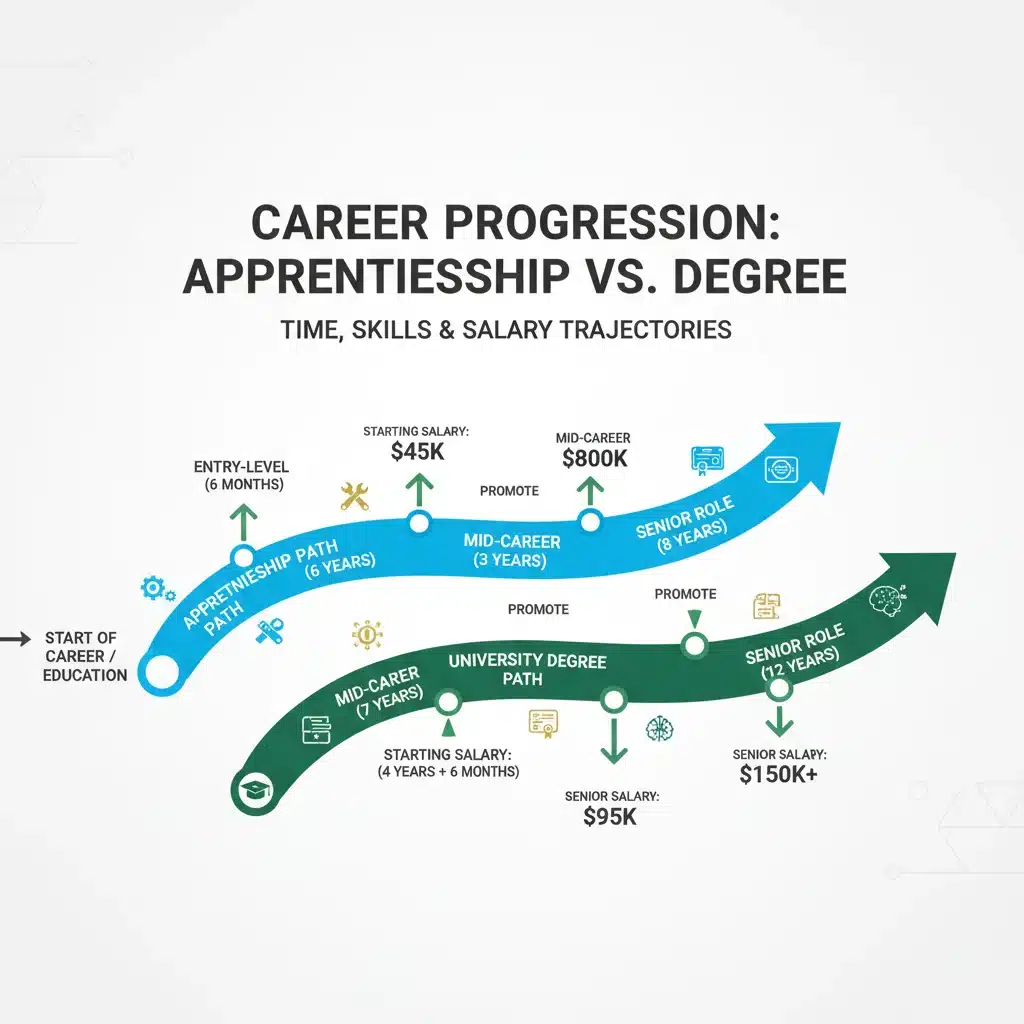
Comparing Career Advancement Pathways: Speed vs. Breadth
When evaluating faster career advancement pathways, it’s essential to define what ‘faster’ truly means. Does it imply quicker entry into a well-paying job, or faster progression to senior leadership roles? Both pathways offer distinct advantages.
Immediate Entry and Earning Potential: Apprenticeships Lead
For individuals seeking immediate entry into the workforce and rapid earning potential, apprenticeships typically hold a significant edge. Apprentices begin earning a wage from day one, often with benefits, and their salaries increase as they gain skills and experience. Upon completing a program (which can be as short as one year), they are usually employed in a skilled position with a competitive salary. This direct transition into a job, without the burden of student debt, allows apprentices to build financial stability and equity much faster.
Consider a high school graduate: an apprentice could be earning a living wage and gaining valuable experience for 3-4 years while their peer is still accumulating debt in college. By the time the degree holder graduates, the apprentice could already be a journeyman, potentially earning more and having years of practical experience under their belt, positioning them for faster career advancement pathways into supervisory or specialized roles.
Long-Term Trajectory and Leadership: Degrees Maintain an Edge (for now)
While apprenticeships offer speed, traditional degrees often provide a broader foundational knowledge that can be advantageous for long-term career flexibility and progression into senior management or executive roles, particularly in large corporations or highly academic fields. The critical thinking and strategic planning skills honed in a university setting are often prerequisites for these positions.
However, this gap is narrowing. Many modern apprenticeship programs are incorporating leadership training, project management, and business acumen into their curriculum. Furthermore, some apprenticeships offer pathways to associate’s or bachelor’s degrees, allowing individuals to combine the best of both worlds – immediate practical experience with academic credentials for advanced career advancement pathways.
Hybrid Models and the Future of Work
The most effective career advancement pathways by 2028 may increasingly involve hybrid models that blend elements of both apprenticeships and degrees. Many community colleges are partnering with industries to offer ‘earn and learn’ programs that integrate academic coursework with paid on-the-job training. Similarly, some universities are developing apprenticeship-like programs or co-op experiences to give students more practical exposure.
The future workforce demands a blend of theoretical understanding and practical application. Individuals who can demonstrate both will be highly sought after. This means that while apprenticeships may offer faster initial career advancement pathways, combining them with targeted higher education (e.g., an associate’s degree after an apprenticeship, or a bachelor’s degree with significant co-op experience) could provide the most robust and flexible path for long-term success.
Case Studies and Real-World Examples
To illustrate the effectiveness of apprenticeships in fostering faster career advancement pathways, let’s look at some examples:
- IT Apprenticeships: In cybersecurity, for instance, an apprentice can start with foundational training, gain certifications, and within 1-2 years be working as a junior security analyst. A degree holder might spend four years in college before landing a similar entry-level role, potentially with less hands-on experience. The apprentice’s direct exposure to real-world threats and systems often accelerates their understanding and ability to contribute meaningfully.
- Advanced Manufacturing: Apprentices in mechatronics or advanced robotics can quickly become highly skilled technicians, responsible for maintaining complex automated systems. Their direct involvement in production and problem-solving allows them to advance to lead technician or supervisory roles much faster than someone entering with only a theoretical engineering degree.
- Healthcare Support Roles: While doctors and nurses require degrees, many critical healthcare support roles (e.g., surgical technologists, medical coders, dental assistants) can be accessed through apprenticeships or vocational training, leading to stable, well-paying jobs and opportunities for specialization and career advancement pathways within a few years.
These examples highlight how apprenticeships are designed for rapid skill acquisition and direct employment, which are key drivers of faster career advancement pathways in specific, high-demand sectors.

Making the Right Choice: Factors to Consider
The decision between an apprenticeship and a traditional degree is highly personal and depends on several factors:
- Career Goals: What kind of work do you want to do? Is it highly specialized and hands-on, or does it require extensive theoretical knowledge and research?
- Learning Style: Do you thrive in a hands-on, practical learning environment, or do you prefer academic theory and classroom-based instruction?
- Financial Situation: Can you afford tuition and living expenses for several years without immediate income, or do you need to earn money while you learn?
- Time Horizon: How quickly do you want to enter the workforce and achieve financial independence?
- Industry Demand: Research the specific industry you’re interested in. What are the common entry requirements and career advancement pathways?
- Long-Term Ambition: Do you aspire to executive leadership or highly specialized technical mastery? Both paths can lead to success, but one might be more direct for your specific ambition.
It’s crucial for individuals to conduct thorough research, speak with professionals in their desired fields, and consider their personal circumstances before committing to either pathway. The landscape is dynamic, and what was true a decade ago may not hold by 2028.
The Role of Policy and Employer Investment
The increasing recognition of apprenticeships as vital career advancement pathways is also driven by supportive policy and growing employer investment. Governments at federal and state levels are providing incentives and funding for apprenticeship programs to address skill gaps and boost economic competitiveness. Employers, facing talent shortages, are increasingly viewing apprenticeships as a strategic talent pipeline, allowing them to train workers precisely to their specifications and foster loyalty.
This institutional support further strengthens the viability and long-term prospects of apprenticeship programs, ensuring their continued expansion into new sectors and their ability to provide robust career advancement pathways for participants. As more companies invest in ‘upskilling’ and ‘reskilling’ through apprenticeships, the opportunities for rapid progression will only multiply.
Conclusion: The Ascendance of Apprenticeships for Rapid Advancement
By 2028, the question of whether apprenticeships or traditional degrees offer faster career advancement pathways in the US will likely see a nuanced answer, but with a clear trend favoring apprenticeships for speed and direct employment in many high-demand fields. While degrees will undoubtedly remain crucial for certain professions and foundational research, the practical, debt-free, and employer-driven nature of apprenticeships positions them as an increasingly powerful engine for rapid professional growth.
For individuals prioritizing immediate entry into a well-paying career, hands-on skill development, and minimal educational debt, apprenticeships present a compelling and often faster route to career advancement. The evolving job market, with its emphasis on specialized technical skills and practical application, is creating an environment where apprentices can quickly become indispensable assets, leading to accelerated promotions and increased earning potential.
Ultimately, the ‘best’ path depends on individual goals and circumstances. However, for those seeking to navigate the modern job market with agility and achieve faster career advancement pathways, apprenticeships are no longer just an alternative but a leading contender, poised to reshape how Americans build successful and fulfilling professional lives.
The shift is not about devaluing degrees but recognizing the immense value and efficiency of applied learning. As we move towards 2028, the smart choice for many seeking rapid professional growth will increasingly involve considering the robust and accelerated career advancement pathways offered by a well-chosen apprenticeship.