
Micro-credentials in the US: A Fast Track to Career Advancement in Specialized Fields by 2026
The landscape of education and employment in the United States is undergoing a seismic shift. Traditional four-year degrees, while still valuable, are increasingly being complemented, and in some cases, challenged, by a burgeoning alternative: micro-credentials. These focused, short-term certifications are rapidly gaining traction as a powerful mechanism for individuals to acquire specialized skills, upskill, and reskill, thereby accelerating their career advancement in an ever-evolving job market. By 2026, the influence of micro-credentials in the US career ecosystem is projected to be immense, fundamentally reshaping how we approach professional development and talent acquisition.
Understanding the Rise of Micro-credentials US Career Impact
What exactly are micro-credentials, and why are they becoming so pivotal for career advancement? Unlike traditional degrees that cover a broad range of subjects over several years, micro-credentials are highly focused programs designed to validate specific competencies or skills. They can range from a few hours to several months in duration and are often offered by universities, community colleges, industry associations, and private training providers. The allure lies in their agility and direct applicability to workforce needs.
Anúncios
The demand for specialized skills is skyrocketing across various sectors. Industries like technology, healthcare, manufacturing, and even creative fields are constantly innovating, creating new roles and requiring new expertise. Employers are increasingly looking for candidates who can demonstrate proficiency in specific, in-demand areas, rather than just possessing a general academic background. This is where micro-credentials in the US career landscape shine. They provide a targeted solution, allowing individuals to quickly gain the exact skills employers are seeking, without the time and financial commitment of a full degree program.
The COVID-19 pandemic further accelerated this trend. As industries pivoted and remote work became normalized, many individuals found themselves needing to adapt their skill sets or transition to new careers entirely. Micro-credentials offered a flexible and efficient pathway to acquire these new competencies, proving their resilience and adaptability in times of crisis. This responsiveness has cemented their role as a vital component of future workforce development strategies.
The Economic Drivers Behind Micro-credentials US Career Growth
Several economic factors are fueling the rapid expansion of micro-credentials in the US career market. Firstly, the escalating cost of traditional higher education has made many individuals hesitant to pursue further degrees, especially if they already hold one. Micro-credentials present a more affordable and time-efficient alternative for professional development. They allow individuals to invest in specific skills that promise a tangible return on investment in terms of job opportunities and increased earning potential.
Anúncios
Secondly, the pace of technological change is relentless. Skills that were valuable five years ago might be obsolete today, and new skills are emerging at an unprecedented rate. This creates a perpetual need for upskilling and reskilling throughout an individual’s career. Micro-credentials are perfectly suited for this continuous learning model, enabling professionals to stay relevant and competitive without disrupting their careers for extended periods.
Thirdly, employers are increasingly recognizing the value of these focused certifications. They offer a clear and verifiable signal of an applicant’s capabilities in a specific area, often more so than a broad degree. Companies are actively partnering with educational institutions and training providers to develop micro-credential programs tailored to their specific talent needs, creating a direct pipeline for skilled workers. This employer-driven demand is a significant catalyst for the growth and acceptance of micro-credentials in the US career market.
Key Sectors Benefiting from Micro-credentials for Career Advancement
The impact of micro-credentials is being felt across a wide array of industries. Some of the most prominent sectors include:
- Technology: Cybersecurity, data science, artificial intelligence, machine learning, cloud computing, web development, and software engineering are prime examples where micro-credentials like Google Career Certificates, IBM Professional Certificates, and various university-led programs are highly sought after. These certifications allow individuals to specialize in niches that are experiencing explosive growth.
- Healthcare: With advancements in medical technology and an aging population, there’s a constant need for specialized skills in areas like health informatics, medical coding, telehealth services, and specific clinical procedures. Micro-credentials offer healthcare professionals opportunities to expand their expertise without committing to lengthy degree programs.
- Manufacturing and Skilled Trades: The rise of Industry 4.0 demands new skills in automation, robotics, advanced manufacturing techniques, and industrial IoT. Micro-credentials can provide rapid training for existing workers to adapt to these new technologies, ensuring a skilled workforce for modern factories.
- Business and Marketing: Digital marketing, project management, business analytics, user experience (UX) design, and supply chain management are areas where micro-credentials can significantly enhance an individual’s value proposition. These skills are critical for businesses operating in a data-driven, globalized economy.
- Education: Educators themselves are utilizing micro-credentials to gain expertise in areas like online pedagogy, educational technology, special education strategies, and curriculum development, enhancing their effectiveness in the classroom and beyond.
The versatility of micro-credentials means that almost any field requiring specialized knowledge or practical skills can benefit from their implementation. This broad applicability underscores their transformative potential for career advancement across the entire US economy.
The Advantages of Pursuing Micro-credentials for Individuals
For individuals, the benefits of pursuing micro-credentials are manifold and directly contribute to accelerated career advancement:
- Targeted Skill Acquisition: Unlike broad degree programs, micro-credentials focus on developing specific, in-demand skills. This means learners spend less time on general education and more time on practical, job-relevant competencies.
- Faster Time to Market: The shorter duration of micro-credentials allows individuals to acquire new skills and enter or re-enter the workforce much faster than traditional education pathways. This is crucial in fast-paced industries where skill sets can become outdated quickly.
- Cost-Effectiveness: Generally, micro-credentials are significantly less expensive than full degree programs, making specialized training more accessible to a wider demographic. This lower financial barrier can encourage more continuous learning throughout a career.
- Flexibility and Accessibility: Many micro-credential programs are offered online or in hybrid formats, providing flexibility for working professionals, parents, and those with other commitments. This accessibility democratizes specialized learning.
- Enhanced Employability and Earning Potential: Possessing verifiable, in-demand skills makes individuals more attractive to employers. Studies and anecdotal evidence suggest that micro-credential holders often see an increase in job opportunities and salary potential.
- Career Pivoting and Transition: For those looking to change careers, micro-credentials offer a strategic way to gain the necessary foundational skills for a new field without starting from scratch with a full degree.
- Demonstrable Competence: Micro-credentials often culminate in a project, exam, or portfolio that directly demonstrates a learner’s mastery of the specific skill, providing tangible proof of their capabilities to potential employers.

These advantages collectively position micro-credentials as a powerful tool for personal and professional growth, empowering individuals to take control of their career trajectories in the dynamic US job market.
Challenges and Considerations for Micro-credentials in the US Career Landscape
While the benefits are clear, the widespread adoption of micro-credentials also presents certain challenges and considerations that need to be addressed to ensure their long-term success and credibility. One primary concern is the lack of standardized accreditation and quality assurance across the vast array of micro-credential providers. Without a universal framework, employers might struggle to differentiate between high-quality, rigorous programs and less reputable offerings. This could lead to a devaluation of some micro-credentials, hindering their effectiveness for career advancement.
Another challenge lies in the recognition and integration of micro-credentials within existing educational and hiring systems. While some employers are actively seeking out candidates with these certifications, others may still primarily value traditional degrees. Bridging this gap requires ongoing communication and collaboration between educational institutions, industry leaders, and policymakers to establish clear pathways for how micro-credentials can stack towards larger qualifications or be formally recognized in hiring processes.
Furthermore, ensuring equitable access to micro-credential programs is crucial. While they are generally more affordable than degrees, the cost can still be a barrier for some individuals, particularly those from underrepresented communities. Initiatives for financial aid, scholarships, and employer-sponsored programs will be vital to ensure that micro-credentials genuinely serve as a tool for upward mobility for everyone, not just those who can afford them.
Finally, the rapid evolution of skills means that micro-credential programs themselves must be agile and regularly updated. Providers must maintain strong ties with industry to ensure their offerings remain relevant and aligned with current workforce demands. This continuous adaptation is both a strength and a challenge, requiring significant investment in curriculum development and expert instruction.
The Role of Employers and Educational Institutions
The success of micro-credentials in the US career ecosystem by 2026 hinges on strong collaboration between employers and educational institutions. Employers play a critical role in articulating their specific skill needs. By clearly communicating the competencies they require, they can guide the development of relevant micro-credential programs. Many forward-thinking companies are already engaging in direct partnerships with universities and community colleges to co-create curricula, ensuring that the skills taught are directly applicable to their workforce demands.
Educational institutions, in turn, must be responsive and innovative. They need to move beyond traditional degree structures and embrace more modular, flexible learning options. This includes developing robust micro-credential programs, ensuring their quality and relevance, and establishing clear pathways for how these credentials can stack towards larger qualifications or be recognized for prior learning. Universities and colleges are uniquely positioned to lend credibility and academic rigor to micro-credential offerings, making them more attractive to learners and employers alike.
Government initiatives and policy support are also crucial. Funding for workforce development programs that incorporate micro-credentials, incentives for employers to hire micro-credential holders, and frameworks for quality assurance can significantly accelerate the adoption and impact of these certifications. The goal is to create an integrated ecosystem where learning is continuous, credentials are recognized, and individuals can seamlessly transition between education and employment.
Forecasting the Impact by 2026: Micro-credentials US Career Landscape Transformed
By 2026, the landscape of career advancement in the US is expected to be significantly transformed by the widespread adoption of micro-credentials. We anticipate several key shifts:
- Hybrid Resumes and Portfolios: Traditional resumes will likely evolve to include a blend of academic degrees, work experience, and a robust section detailing specific micro-credentials and the skills they represent. Digital portfolios showcasing projects completed through micro-credential programs will become commonplace.
- Skills-Based Hiring Dominance: Employers will increasingly prioritize skills-based hiring over degree-based hiring, particularly for specialized roles. Micro-credentials will provide verifiable proof of these skills, making them a powerful tool for job seekers.
- Continuous Learning as the Norm: The concept of lifelong learning will transition from an aspiration to a necessity. Professionals will routinely pursue micro-credentials to update their skills, adapt to technological advancements, and maintain their competitive edge throughout their careers.
- Personalized Career Pathways: Individuals will have greater agency in designing their own career pathways, stacking micro-credentials from various providers to create highly customized skill sets that align with their professional goals and market demands.
- Increased Economic Mobility: For individuals from underserved communities or those without access to traditional higher education, micro-credentials will offer a more accessible and affordable route to acquire high-demand skills, thereby fostering greater economic mobility and reducing skill gaps.
- Closer Industry-Education Alignment: The collaboration between industry and education will deepen, leading to more responsive and relevant training programs that directly address workforce needs, reducing the mismatch between skills taught and skills required.
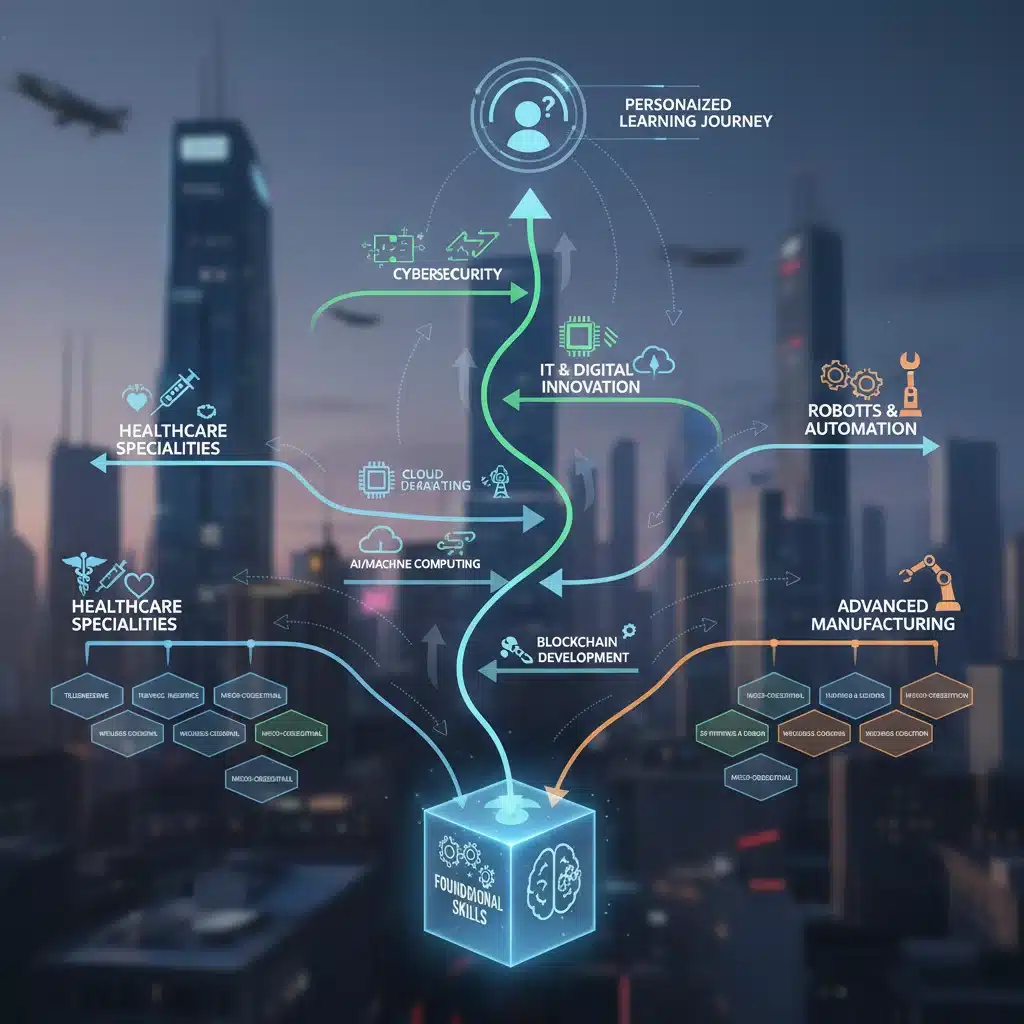
The shift towards a micro-credential-driven workforce is not merely a trend; it represents a fundamental re-evaluation of how we value and acquire skills. It’s about empowering individuals to navigate a dynamic job market with agility and precision, ensuring that the US workforce remains innovative and competitive on a global scale.
How to Leverage Micro-credentials for Your Career Advancement
If you’re looking to accelerate your career advancement by 2026, embracing micro-credentials is a strategic move. Here’s how to effectively leverage them:
- Identify In-Demand Skills: Research your industry and desired career path to identify the most sought-after skills. Look at job descriptions, industry reports, and professional networking sites. Tools like LinkedIn Learning, Coursera, and edX often highlight trending skills.
- Choose Reputable Providers: Opt for micro-credentials offered by accredited universities, well-known tech companies (e.g., Google, IBM, Microsoft), or reputable industry associations. Look for programs with clear learning outcomes and demonstrable projects.
- Align with Your Goals: Select micro-credentials that directly support your career objectives, whether it’s upskilling in your current role, transitioning to a new field, or preparing for a promotion.
- Showcase Your Achievements: Don’t just earn the credential; actively showcase it. Add it to your resume, LinkedIn profile, and professional portfolio. Be ready to discuss how the skills you gained are applicable to job roles.
- Network with Peers and Mentors: Engage with others who are pursuing or have completed similar micro-credentials. Networking can open doors to new opportunities and provide valuable insights.
- Consider Stacking Credentials: Explore providers that offer ‘stackable’ micro-credentials, where multiple certifications can build towards a larger certificate or even a degree, providing a flexible pathway to higher qualifications.
- Continuous Learning Mindset: View micro-credentials as part of an ongoing learning journey. The most successful professionals in 2026 will be those who consistently update their skill sets.
By proactively engaging with the micro-credential ecosystem, individuals can strategically position themselves for success in the rapidly evolving US career landscape.
The Future is Modular: Micro-credentials and the New Learning Paradigm
The shift towards micro-credentials signifies a broader transformation in how we conceive of education and professional development. The traditional, linear path of education followed by a static career is being replaced by a more dynamic, modular approach. Learning is becoming a continuous loop, integrated throughout one’s professional life, rather than a discrete phase. Micro-credentials are at the forefront of this new paradigm, offering granular, on-demand learning that aligns perfectly with the demands of the modern economy.
This modular approach to learning and credentialing offers unprecedented flexibility and personalization. It allows individuals to acquire skills precisely when they need them, without the overhead of traditional degree programs. For employers, it means access to a workforce that is constantly adapting and acquiring the most current, relevant skills. As we move towards 2026, the success of the US workforce will increasingly depend on its ability to embrace this agile, skills-first approach, with micro-credentials serving as a cornerstone of this educational revolution.
In conclusion, micro-credentials are not just a passing trend; they are a fundamental shift in how skills are acquired, validated, and valued in the United States. By 2026, their integration into the US career landscape will be profound, offering a fast track to career advancement, fostering economic mobility, and ensuring that individuals and industries alike can thrive in an increasingly complex and competitive global environment. Embracing micro-credentials is not just about staying relevant; it’s about leading the way into the future of work.