Capital Gains Tax Adjustments 2026: Minimize Your Investment Liabilities

Anúncios
The financial landscape is ever-evolving, and staying ahead of tax law changes is paramount for savvy investors. As we approach 2026, significant Capital Gains Tax 2026 adjustments are on the horizon, promising to reshape how individuals and businesses manage their investment portfolios. Understanding these potential changes and strategically planning for them can be the difference between significant tax liabilities and optimized financial growth. This comprehensive guide will delve into the anticipated adjustments, provide actionable strategies to minimize your tax burden, and equip you with the knowledge to navigate the future with confidence. Our goal is to help you reduce your investment liabilities by up to 5% through proactive and informed decisions.
Anúncios
Understanding Capital Gains Tax: A Foundation for 2026 Planning
Before we dissect the upcoming Capital Gains Tax 2026 adjustments, it’s crucial to have a solid grasp of what capital gains tax entails. Simply put, capital gains tax is a tax levied on the profit realized from the sale of a non-inventory asset that was purchased at a lower price. These assets can include stocks, bonds, real estate, precious metals, and even collectibles. The tax rate applied depends on several factors, primarily the holding period of the asset and your overall income level.
Short-Term vs. Long-Term Capital Gains
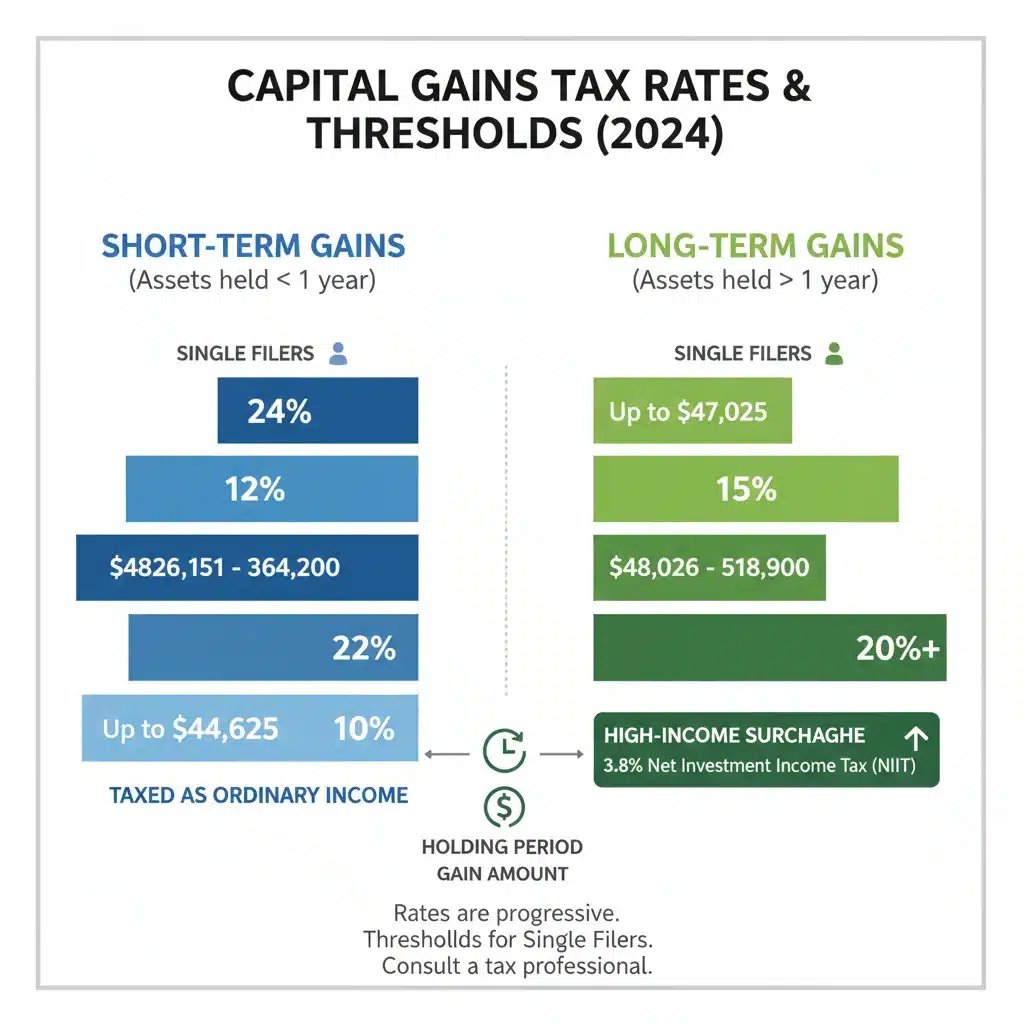
The distinction between short-term and long-term capital gains is fundamental. Short-term capital gains are profits from assets held for one year or less, and they are typically taxed at your ordinary income tax rates, which can be as high as 37% for the top brackets. Conversely, long-term capital gains are profits from assets held for more than one year, and these often benefit from preferential tax rates, currently ranging from 0%, 15%, or 20%, depending on your taxable income. This distinction is critical because the anticipated Capital Gains Tax 2026 changes might significantly alter these rates or the thresholds at which they apply.
The Importance of Basis and Netting
To calculate your capital gain, you need to determine the ‘basis’ of your asset, which is generally the original cost plus any commissions or fees. Your gain is the sale price minus this basis. Furthermore, capital gains and losses can be ‘netted’ against each other. Capital losses can offset capital gains, and if your losses exceed your gains, you can deduct up to $3,000 of those losses against your ordinary income each year, carrying forward any remaining losses to future tax years. Understanding these basic principles is the bedrock for effective planning for the Capital Gains Tax 2026 modifications.
Anúncios
Anticipated Capital Gains Tax Adjustments for 2026
While specific legislative details are still emerging, several key areas are likely to see adjustments concerning Capital Gains Tax 2026. These potential changes are often driven by economic policy objectives, such as revenue generation, wealth redistribution, or incentivizing specific types of investment. Staying informed about these potential shifts is the first step in proactive tax planning.
Potential Increases in Long-Term Capital Gains Rates
One of the most widely discussed possibilities is an increase in the long-term capital gains tax rates, particularly for high-income earners. The current preferential rates might be adjusted upwards, or the income thresholds for these rates could be lowered, effectively subjecting more individuals to higher tax percentages. For instance, the top 20% rate could climb to 25% or even higher for certain income brackets. Such a change would significantly impact investment strategies, making it crucial to evaluate your portfolio now.
Changes to the Holding Period Definition
Another area ripe for adjustment could be the definition of the long-term holding period. Lawmakers might consider extending the one-year threshold to two or even three years to qualify for preferential rates. This would mean investors would need to hold assets for a longer duration to benefit from lower tax rates, fundamentally altering short-term trading strategies and emphasizing long-term investment horizons. This particular adjustment would have a profound effect on how investors approach market fluctuations and their selling decisions, especially concerning Capital Gains Tax 2026.
Modifications to Estate and Gift Tax Rules
While not directly Capital Gains Tax 2026, changes to estate and gift tax rules often have indirect implications for capital gains planning, especially concerning inherited assets. The ‘step-up in basis’ rule, which resets the cost basis of inherited assets to their fair market value at the time of the owner’s death, is frequently debated. Any modification or elimination of this rule could lead to significant capital gains liabilities for beneficiaries who later sell inherited assets, making pre-death planning even more critical.
Impact of Inflation Adjustments
Inflation is a persistent economic factor, and tax codes often include provisions for inflation adjustments. While these typically prevent ‘bracket creep’ for ordinary income, the mechanisms for adjusting capital gains thresholds or specific tax benefits for inflation could also be reviewed or altered. Understanding how inflation might indirectly affect your capital gains calculations is an often-overlooked aspect of tax planning for Capital Gains Tax 2026.
Strategic Planning to Minimize Capital Gains Tax Liabilities by 5%
Minimizing your Capital Gains Tax 2026 liabilities requires a proactive and multi-faceted approach. By implementing these strategies, you can potentially reduce your tax burden by 5% or more, freeing up capital for further investment or personal use.
1. Tax-Loss Harvesting: A Timeless Strategy
Tax-loss harvesting involves selling investments at a loss to offset capital gains and, if applicable, a limited amount of ordinary income. This strategy is particularly powerful towards the end of the year but can be employed anytime market conditions present opportunities. By strategically realizing losses, you can reduce your overall taxable capital gains. For example, if you have $10,000 in capital gains from one investment and $7,000 in capital losses from another, you can use the losses to offset the gains, reducing your taxable gains to $3,000. Any excess losses (up to $3,000 per year) can then be used to offset ordinary income. This strategy becomes even more vital in anticipation of higher Capital Gains Tax 2026 rates.
2. Maximizing Tax-Advantaged Accounts
One of the most effective ways to shield your investments from capital gains tax is to utilize tax-advantaged accounts. These include:
- 401(k)s and IRAs: Contributions to traditional 401(k)s and IRAs are often tax-deductible, and investments grow tax-deferred until retirement. Withdrawals in retirement are taxed as ordinary income, but you avoid capital gains tax on the growth within the account.
- Roth IRAs and Roth 401(k)s: Contributions are made with after-tax dollars, but qualified withdrawals in retirement are completely tax-free, including all capital gains. This makes them incredibly powerful for long-term growth.
- 529 Plans: Designed for education savings, these plans allow investments to grow tax-free, and withdrawals for qualified educational expenses are also tax-free.
- Health Savings Accounts (HSAs): Often called a ‘triple tax advantage’ account, contributions are tax-deductible, investments grow tax-free, and withdrawals for qualified medical expenses are tax-free. HSAs can also function as an investment vehicle after a certain age.
Increasing your contributions to these accounts now can significantly reduce your future Capital Gains Tax 2026 exposure.
3. Long-Term Holding and Strategic Asset Allocation
As mentioned, holding assets for more than a year typically qualifies them for lower long-term capital gains rates. In anticipation of potential changes to the holding period for Capital Gains Tax 2026, it might be wise to prioritize a long-term investment strategy. Review your portfolio for any assets you might be considering selling in the near future and assess if holding them for a longer period could result in significant tax savings. Additionally, consider how your assets are allocated across different investment vehicles. For instance, placing high-growth assets that generate significant capital gains in tax-advantaged accounts can be a smart move.
4. Gifting Appreciated Assets
Gifting appreciated assets to individuals in lower tax brackets can be an effective strategy, particularly for large families or philanthropic endeavors. When you gift an appreciated asset, the recipient inherits your cost basis. If they are in a lower tax bracket and sell the asset, they will pay a lower capital gains tax rate than you would have. This strategy needs careful planning to avoid gift tax implications, but it can be a powerful tool for overall family wealth management and minimizing Capital Gains Tax 2026 across generations.
5. Charitable Contributions of Appreciated Stock
Donating appreciated stock directly to a qualified charity can provide a dual tax benefit. You generally avoid paying capital gains tax on the appreciated value of the stock, and you can typically deduct the fair market value of the stock as a charitable contribution on your income tax return (subject to certain limitations). This is often more advantageous than selling the stock, paying the capital gains tax, and then donating the cash. This strategy can be particularly impactful for highly appreciated assets and can significantly reduce your Capital Gains Tax 2026 burden.
The Role of Professional Guidance for Capital Gains Tax 2026
Navigating the complexities of tax law, especially with impending changes, can be daunting. Engaging with qualified financial and tax professionals is not just advisable; it’s often essential for optimizing your strategy concerning Capital Gains Tax 2026.
Financial Advisors: Holistic Portfolio Management
A financial advisor can help you assess your current investment portfolio, understand your risk tolerance, and align your investment strategy with your long-term financial goals. They can provide guidance on asset allocation, rebalancing, and identifying opportunities for tax-loss harvesting. With their expertise, you can construct a portfolio that is not only geared for growth but also structured to be tax-efficient in light of the Capital Gains Tax 2026 adjustments.
Tax Professionals: Expert Interpretation and Compliance
A certified public accountant (CPA) or a tax attorney specializes in tax law and can offer detailed advice on how the Capital Gains Tax 2026 changes will specifically impact your situation. They can help you understand the nuances of the new regulations, ensure compliance, and identify every legitimate deduction and credit available to you. Their insights are invaluable for complex situations, such as inherited assets, business sales, or multi-jurisdictional investments.
Proactive Steps to Take Now for Capital Gains Tax 2026
The time to prepare for Capital Gains Tax 2026 is now. Delaying your planning could lead to missed opportunities and increased tax liabilities. Here are some immediate steps you can take:
1. Review Your Investment Portfolio
Conduct a thorough review of all your investment holdings. Identify assets with significant unrealized gains and those with unrealized losses. Understand the cost basis for each asset and its holding period. This comprehensive overview will be the foundation for any strategic decisions you make.
2. Consult with Your Financial and Tax Advisors
Schedule meetings with your financial advisor and tax professional. Share your current financial situation, investment goals, and any concerns you have about the upcoming tax changes. Work collaboratively to develop a personalized strategy that accounts for the anticipated Capital Gains Tax 2026 adjustments.
3. Consider Accelerating Income or Deferring Deductions
Depending on your income level and the specific nature of the Capital Gains Tax 2026 changes, it might be beneficial to accelerate income into the current tax year or defer deductions to a later year. This strategy is highly dependent on your individual circumstances and the projected tax rates, so professional advice is crucial.
4. Rebalance Your Portfolio Strategically
Use any necessary portfolio rebalancing as an opportunity for tax efficiency. Instead of simply selling appreciated assets, look for opportunities to sell assets at a loss to offset gains, or consider gifting appreciated assets to charity. This strategic rebalancing can help manage your Capital Gains Tax 2026 exposure.
5. Stay Informed About Legislative Developments
Tax laws are dynamic. While we’ve discussed anticipated changes, the exact details of the Capital Gains Tax 2026 adjustments will depend on ongoing legislative processes. Stay informed by following reputable financial news sources and maintaining regular communication with your advisors. Be prepared to adapt your strategies as new information becomes available.

Case Studies: Applying Capital Gains Tax 2026 Strategies
To illustrate the practical application of these strategies, let’s consider a few hypothetical scenarios:
Case Study 1: The High-Income Investor
Sarah is a high-income earner with a significant stock portfolio. She anticipates selling a highly appreciated stock in late 2025 or early 2026. With potential increases in the long-term Capital Gains Tax 2026 rate for her income bracket, her advisor recommends accelerating the sale into late 2025 if the current rates are more favorable. Additionally, they identify other investments in her portfolio that have experienced losses, which she can sell to offset a portion of her gains from the appreciated stock, further reducing her tax liability.
Case Study 2: The Retiree Planning for Withdrawals
John is nearing retirement and plans to start drawing income from his investment accounts. He holds a mix of traditional IRA, Roth IRA, and taxable brokerage accounts. His advisor suggests strategically converting a portion of his traditional IRA to a Roth IRA in 2025, before potential Capital Gains Tax 2026 increases take effect. While this conversion is taxable as ordinary income, future withdrawals from the Roth IRA, including any capital gains, will be tax-free, protecting him from higher rates in retirement.
Case Study 3: The Philanthropic Investor
Maria is passionate about a local charity and holds a substantial amount of stock she purchased years ago that has significantly appreciated. Her advisor recommends donating a portion of this highly appreciated stock directly to the charity instead of selling it and donating the cash. This allows Maria to avoid capital gains tax on the appreciated value and claim a charitable deduction for the full fair market value of the stock, effectively minimizing her Capital Gains Tax 2026 exposure and maximizing her philanthropic impact.
Conclusion: Embracing Proactive Tax Planning for 2026
The anticipated Capital Gains Tax 2026 adjustments represent both challenges and opportunities for investors. While the prospect of higher taxes might seem daunting, a proactive and well-informed approach can significantly mitigate their impact. By understanding the potential changes, implementing strategic tax-minimization techniques like tax-loss harvesting and maximizing tax-advantaged accounts, and seeking expert professional guidance, you can navigate the evolving tax landscape with confidence. Remember, the goal is not just to comply with tax laws, but to optimize your financial outcomes and preserve your wealth. Start your planning today to ensure you’re well-positioned for the future and can potentially reduce your investment liabilities by 5% or more.
Author