2026 Student Loan Refinancing: Federal vs. Private Options for US Borrowers

Anúncios
2026 Student Loan Refinancing: Federal vs. Private Options for US Borrowers
As we approach 2026, millions of U.S. borrowers continue to grapple with student loan debt. The landscape of student loan management is constantly evolving, with new policies, interest rate fluctuations, and innovative financial products emerging regularly. For many, student loan refinancing 2026 represents a significant opportunity to reduce monthly payments, lower interest rates, or simplify their repayment strategy. This comprehensive guide will delve into the intricacies of both federal and private student loan refinancing options, helping you make an informed decision tailored to your unique financial situation.
Understanding the nuances between federal and private refinancing is crucial. Each path offers distinct advantages and disadvantages that can profoundly impact your financial well-being. Whether you’re aiming for a lower interest rate, more flexible repayment terms, or a streamlined loan portfolio, exploring all avenues is the first step toward effective debt management. Let’s embark on this journey to demystify student loan refinancing 2026 and empower you with the knowledge to make the best choice.
Anúncios
What is Student Loan Refinancing?
Student loan refinancing involves taking out a new loan to pay off one or more existing student loans. The goal is typically to secure a lower interest rate, reduce your monthly payments, or change your loan term. When you refinance, your old loans are paid off, and you’re left with a single new loan, ideally with more favorable terms. This process can apply to both federal and private student loans, though the options available for each type differ significantly.
Key Benefits of Refinancing
- Lower Interest Rate: This is often the primary motivation. A lower interest rate can save you thousands of dollars over the life of the loan.
- Reduced Monthly Payments: By extending the loan term or securing a lower rate, you can decrease your monthly financial burden.
- Simpler Repayment: Consolidating multiple loans into one can make tracking payments much easier.
- Change Loan Term: You can choose a shorter term to pay off debt faster (and save on interest) or a longer term to reduce monthly payments.
- Switching from Variable to Fixed Rate (or vice-versa): Refinancing allows you to lock in a fixed rate for predictability or opt for a variable rate if you anticipate interest rates falling.
Who Should Consider Refinancing in 2026?
Refinancing isn’t for everyone, but certain individuals stand to benefit the most. If you have a stable income, a good to excellent credit score, and a manageable debt-to-income ratio, you are a strong candidate. Additionally, if interest rates have dropped since you took out your original loans, or if your credit score has significantly improved, refinancing could be particularly advantageous. For those looking to optimize their financial situation in 2026, understanding these factors is paramount.
Anúncios
Federal Student Loan Refinancing in 2026: The Nuances
It’s crucial to clarify a common misconception: you cannot directly refinance federal student loans through the federal government into a new federal loan with a lower interest rate. What the federal government offers is called Direct Loan Consolidation. This process combines multiple federal student loans into a single new Direct Consolidation Loan. While it simplifies payments and can open doors to certain income-driven repayment plans or public service loan forgiveness (PSLF), it generally does not lower your interest rate. Instead, the interest rate for a Direct Consolidation Loan is the weighted average of the interest rates of the loans being consolidated, rounded up to the nearest one-eighth of a percentage point.
Direct Loan Consolidation: Benefits and Drawbacks
Benefits:
- One Monthly Payment: Simplifies your financial life by consolidating multiple federal loans into a single bill.
- Access to Income-Driven Repayment (IDR) Plans: If you have older federal loans (like FFEL Program loans) that aren’t eligible for certain IDR plans, consolidation can make them eligible.
- Eligibility for Public Service Loan Forgiveness (PSLF): Consolidation is often a necessary step for borrowers seeking PSLF, especially if they have non-Direct federal loans.
- Extended Repayment Period: Can extend your repayment term up to 30 years, lowering monthly payments (though increasing total interest paid).
Drawbacks:
- No Interest Rate Reduction: As mentioned, the interest rate is a weighted average, not a reduction.
- Loss of Borrower Benefits: You might lose certain benefits associated with your original loans, such as interest rate discounts or principal rebates.
- Restarting PSLF/IDR Clock: If you consolidate loans for which you’ve already made qualifying payments toward PSLF or IDR forgiveness, the payment count typically resets to zero. However, recent limited waivers have provided exceptions, so always check the latest federal guidance for 2026.
Federal Student Loan Landscape in 2026
The federal student loan landscape is subject to legislative changes and policy updates. Borrowers should stay informed about any new acts or initiatives that might impact repayment options, interest rates, or forgiveness programs in 2026. Monitoring official Department of Education announcements is crucial for understanding the most current federal options available for student loan refinancing 2026 through consolidation.
Private Student Loan Refinancing in 2026: A Closer Look
Private student loan refinancing is where borrowers can truly seek a lower interest rate. Unlike federal consolidation, private lenders aim to attract borrowers with excellent credit by offering more competitive rates. When you refinance with a private lender, they pay off your existing federal or private loans, and you then owe the new private lender.
How Private Refinancing Works
Private lenders evaluate your creditworthiness to determine your eligibility and interest rate. Key factors include:
- Credit Score: A high credit score (typically 670+ for good, 740+ for excellent) is paramount.
- Income: Lenders want to see stable employment and sufficient income to comfortably make payments.
- Debt-to-Income Ratio: A lower DTI indicates you have more disposable income to cover new loan payments.
- Co-signer: If your credit or income isn’t strong enough, a creditworthy co-signer can significantly improve your chances of approval and secure a better rate.
Choosing Between Fixed and Variable Rates
Private lenders typically offer both fixed and variable interest rates:
- Fixed-Rate Loans: Your interest rate remains the same for the life of the loan. This offers predictability and stability in your monthly payments. It’s often preferred if you anticipate rising interest rates or simply value consistent payments.
- Variable-Rate Loans: Your interest rate can fluctuate based on market indices (like the prime rate or LIBOR/SOFR). While these often start lower than fixed rates, they can increase over time, leading to higher monthly payments. They might be suitable if you expect to pay off your loan quickly or if you believe interest rates will fall.
For student loan refinancing 2026, carefully consider the economic outlook and your risk tolerance before choosing between these two rate types.
Benefits of Private Refinancing
- Potentially Lower Interest Rates: This is the biggest draw, especially if you have excellent credit.
- Simplified Payments: Combine multiple loans (federal and/or private) into one payment with one lender.
- Release a Co-signer: If your original loans had a co-signer, refinancing in your name alone can release them from their obligation.
- Option to Change Loan Term: Tailor your repayment period to fit your financial goals.
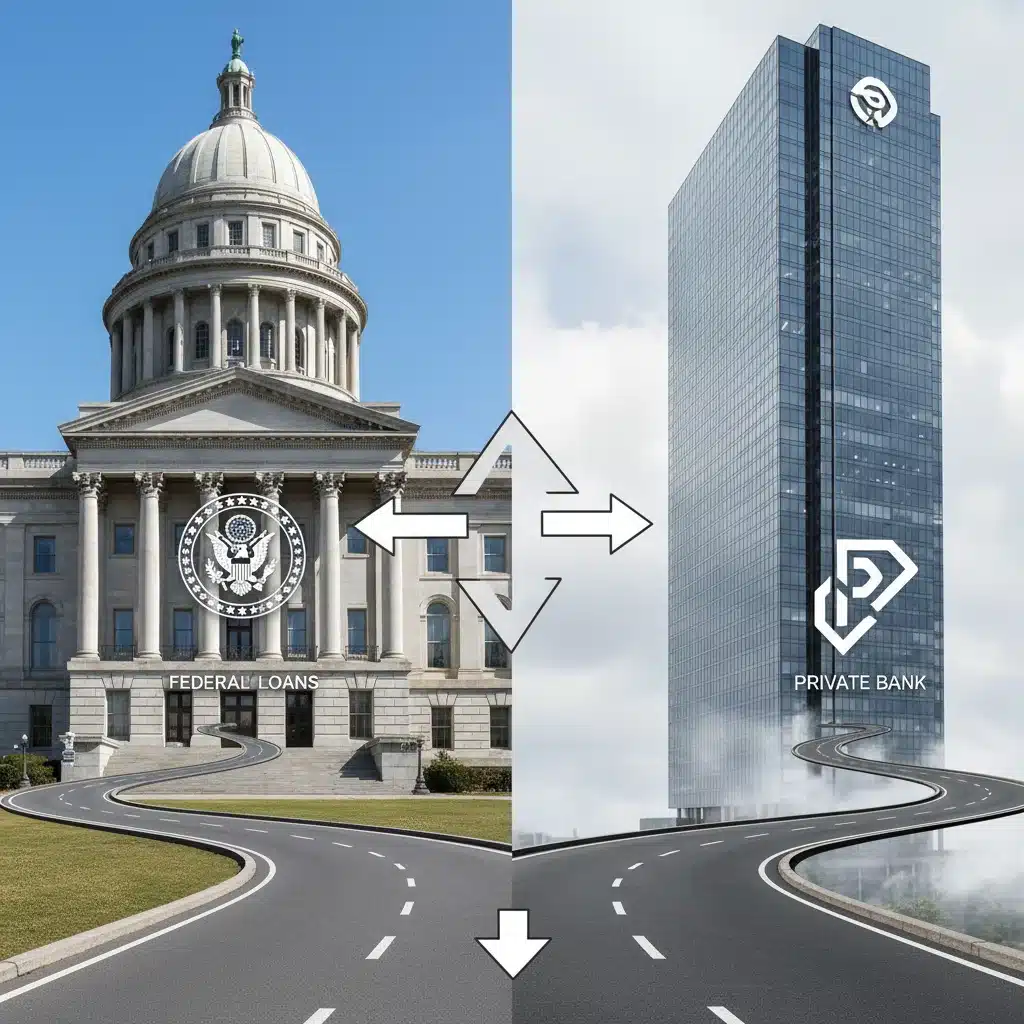
Drawbacks of Private Refinancing
- Loss of Federal Loan Protections: This is the most significant drawback. Refinancing federal loans into a private loan means forfeiting crucial federal benefits such as income-driven repayment plans, generous deferment and forbearance options, and access to federal loan forgiveness programs (like PSLF).
- Credit-Dependent: Requires good to excellent credit to qualify for the best rates.
- Fewer Flexible Repayment Options: Private lenders generally offer less flexibility compared to federal programs if you face financial hardship.
Comparing Federal and Private Refinancing Options in 2026
Making the right choice for student loan refinancing 2026 hinges on a thorough comparison of what federal consolidation and private refinancing offer. It’s not a one-size-fits-all decision.
Key Considerations for Federal Loans
If you have federal student loans, ask yourself the following:
- Do I anticipate needing income-driven repayment plans? If your income is variable or you foresee periods of financial difficulty, federal IDR plans can be a lifeline.
- Am I pursuing Public Service Loan Refinancing (PSLF) or other federal forgiveness programs? Refinancing federal loans privately will disqualify you from these programs.
- Do I value federal loan deferment and forbearance options? These safety nets are often more robust and accessible with federal loans.
- Are my current federal loan interest rates already low? If so, the potential savings from private refinancing might not outweigh the loss of federal protections.
Key Considerations for Private Loans
If you’re considering private refinancing, evaluate these points:
- Is my credit score strong enough to secure a significantly lower interest rate? Use online tools to get pre-qualified without impacting your credit score.
- Is my income stable, and do I have a low debt-to-income ratio? Lenders will scrutinize your ability to repay.
- Do I have an emergency fund and job security? Since private loans offer fewer hardship protections, a financial buffer is essential.
- Are the potential interest savings substantial enough to warrant giving up federal benefits? Calculate the exact savings to make an informed decision.
- Do I have a mix of federal and private loans? You can choose to refinance only your private loans, or only your federal loans (into a private loan), or both.
Hybrid Approach: A Smart Strategy for Some
A common and often effective strategy for student loan refinancing 2026 is a hybrid approach. This involves:
- Consolidating federal loans if it benefits access to IDR or PSLF, or simplifies payments without losing critical protections.
- Refinancing private loans separately with a private lender to secure a lower interest rate.
This approach allows you to retain federal benefits on your federal debt while optimizing the cost of your private debt. It’s a nuanced strategy that requires careful planning but can yield the best of both worlds.
Eligibility Requirements for 2026 Student Loan Refinancing
Whether you’re looking at federal consolidation or private refinancing, certain eligibility criteria must be met.
Federal Direct Loan Consolidation Eligibility
- You must have eligible federal student loans (most federal loans qualify).
- The loans must be in repayment or in the grace period.
- You generally cannot consolidate a loan that is in default unless you’ve made satisfactory repayment arrangements or agree to repay under an IDR plan.
Private Refinancing Eligibility
Private lenders have stricter and more varied requirements:
- Credit Score: As mentioned, a strong credit score is vital. Lenders may look for scores in the high 600s to mid-700s and above.
- Income and Employment: Proof of stable income and employment history is usually required.
- Debt-to-Income Ratio (DTI): Lenders assess your DTI to ensure you can handle the new monthly payments.
- Graduation: Many private lenders require you to have graduated with a bachelor’s degree or higher. Some may refinance without a degree if you have significant work experience and a strong financial profile.
- U.S. Citizenship or Permanent Residency: Most lenders require you to be a U.S. citizen or permanent resident, though some may work with international students with a creditworthy U.S. co-signer.
It’s advisable to check with several private lenders in 2026 to compare their specific eligibility criteria and loan offerings.
The Application Process for Student Loan Refinancing in 2026
The application process for federal consolidation and private refinancing differs. Understanding these steps can help you prepare.
Federal Direct Loan Consolidation Application
The application for a Direct Consolidation Loan is completed through the Federal Student Aid website (StudentAid.gov). You’ll need to:
- Log in with your FSA ID.
- Select the loans you wish to consolidate.
- Choose a repayment plan (e.g., Standard, Graduated, or an Income-Driven Repayment Plan).
- Review and submit the application.
The process is generally straightforward and can be completed online. It typically takes a few weeks to process.
Private Refinancing Application
The private refinancing application process involves:
- Researching Lenders: Compare rates, terms, and customer reviews from multiple private lenders offering student loan refinancing 2026.
- Pre-qualification: Many lenders offer a pre-qualification process that allows you to see potential rates without a hard credit inquiry. This is highly recommended.
- Gathering Documents: You’ll typically need income verification (pay stubs, tax returns), loan statements for the loans you want to refinance, and possibly proof of graduation.
- Submitting Application: Complete the full application, which will involve a hard credit inquiry.
- Loan Approval and Disbursement: If approved, you’ll sign loan documents, and the new lender will pay off your old loans.
This process can take anywhere from a few weeks to a couple of months, depending on the lender and the completeness of your documentation.

Factors to Consider Before Refinancing in 2026
Before committing to student loan refinancing 2026, take a moment to consider these critical factors:
Current Interest Rate Environment
Keep an eye on prevailing interest rates. If rates are low, it might be an opportune time to refinance. Conversely, if rates are high and expected to fall, you might consider a variable rate or waiting. Economic forecasts for 2026 will play a significant role in this decision.
Your Financial Goals
- Debt-Free Faster: If your primary goal is to pay off debt quickly, a shorter loan term with a higher monthly payment might be ideal.
- Lower Monthly Payments: If cash flow is a concern, extending the loan term can reduce monthly payments, though you’ll pay more interest over time.
- Predictability: A fixed interest rate offers stability, which is valuable for budgeting.
Job Security and Income Stability
Private loans offer fewer protections if you lose your job or face a significant income reduction. Ensure your employment is stable and you have an adequate emergency fund before giving up federal benefits.
Potential for Forgiveness or IDR
Reiterate the importance of federal loan forgiveness programs (like PSLF) and income-driven repayment plans. If these are part of your long-term strategy, refinancing federal loans privately is likely not the right move.
Read the Fine Print
Always read the loan agreement carefully. Look for any fees (origination fees, prepayment penalties), terms, and conditions. Understand the interest rate (APR vs. nominal rate) and how it’s calculated.
Tips for Maximizing Your Refinancing Success in 2026
To ensure you get the best possible outcome from your student loan refinancing 2026 efforts, consider these tips:
- Improve Your Credit Score: Before applying, take steps to boost your credit score. Pay bills on time, reduce credit card debt, and check your credit report for errors.
- Shop Around: Get quotes from at least three to five different private lenders. Rates and terms can vary significantly.
- Consider a Co-signer: If your credit score isn’t stellar, a creditworthy co-signer can help you qualify for a much better interest rate. Ensure your co-signer understands their responsibilities.
- Automate Payments: Many lenders offer a small interest rate discount (e.g., 0.25%) for setting up automatic payments. This also helps ensure you don’t miss payments.
- Understand Your Break-Even Point: If you’re considering refinancing a federal loan into a private one, calculate how much you’d save in interest versus the value of the federal protections you’d lose.
- Stay Informed: The student loan landscape is dynamic. Keep up-to-date with federal policy changes and market interest rate trends throughout 2026.
Conclusion: Making the Right Refinancing Decision in 2026
The decision to pursue student loan refinancing 2026 is a significant financial one that requires careful consideration. There’s no universal ‘best’ option; the ideal path depends entirely on your individual circumstances, financial goals, and risk tolerance. For federal student loans, Direct Loan Consolidation offers simplification and access to crucial federal protections but generally won’t lower your interest rate. Private refinancing, on the other hand, presents the opportunity for substantial interest savings, especially for borrowers with excellent credit, but at the cost of federal benefits.
Take the time to thoroughly evaluate your current loans, understand the pros and cons of each refinancing type, and assess your financial stability. Utilize online calculators, seek pre-qualification from multiple lenders, and if necessary, consult with a financial advisor. By doing your due diligence and staying informed about the evolving financial landscape in 2026, you can make a strategic decision that empowers you to take control of your student loan debt and achieve greater financial freedom. Your journey towards optimized student loan repayment begins with understanding your options and making an informed choice for your future.
Author