The economic landscape is a constantly shifting terrain, influenced by a myriad of factors, both domestic and global. At the heart of this intricate system, particularly in the United States, stands the Federal Reserve. Its decisions, especially concerning interest rates, reverberate through every sector of the economy, affecting everything from housing markets to corporate investments, and individual savings to global trade. As we look towards 2026, understanding the potential strategies and outlook of the Federal Reserve becomes paramount for anyone looking to navigate the future financial environment effectively. This deep dive into the Federal Reserve’s 2026 interest rate strategy aims to unravel the complexities, anticipate potential shifts, and analyze their profound economic implications.
The Federal Reserve operates with a dual mandate: to foster maximum employment and maintain price stability. These two objectives often require a delicate balancing act, especially in dynamic economic conditions. By adjusting the federal funds rate, the Fed influences borrowing costs throughout the economy, thereby impacting spending, investment, and inflation. Predicting the Federal Reserve’s 2026 strategy involves analyzing current economic trends, understanding the Fed’s historical responses, and considering potential future scenarios that could alter its course.
Anúncios
The Current Economic Climate: A Precursor to 2026
Before we can project into 2026, it’s crucial to establish a baseline from the present economic reality. The post-pandemic era has been characterized by unique challenges: supply chain disruptions, elevated inflation, and a tight labor market. The Federal Reserve responded aggressively to rising inflation, implementing a series of significant interest rate hikes. These actions, while necessary to cool down an overheating economy, also carry the risk of slowing growth too much, potentially leading to a recession. The trajectory of inflation, the resilience of the labor market, and the overall pace of economic growth in the immediate years leading up to 2026 will heavily dictate the Fed’s stance.
Inflation, in particular, remains a key concern. While there have been signs of moderation, achieving the Fed’s long-term target of 2% sustained inflation is a complex task. Geopolitical events, energy prices, and global demand can all exert upward pressure on prices, making the Fed’s job even harder. The labor market, despite some cooling, has remained remarkably robust. A strong labor market typically supports consumer spending, but it can also contribute to wage-price spirals if not managed carefully. The balance between these forces will be critical for the Federal Reserve 2026 outlook.
Key Factors Influencing the Federal Reserve 2026 Strategy
Several pivotal factors will shape the Federal Reserve’s interest rate decisions in 2026. Understanding these influences is essential for anticipating policy shifts.
Anúncios
Inflationary Pressures and Expectations
The primary driver of recent Fed policy has been inflation. By 2026, the Fed will be closely monitoring whether inflation has sustainably returned to its 2% target. If inflationary pressures persist due to factors like supply chain issues, geopolitical tensions, or strong consumer demand, the Fed may maintain a restrictive stance or even consider further hikes. Conversely, if inflation cools more rapidly than expected, the Fed could pivot to a more accommodative policy.
Labor Market Dynamics
The health of the labor market is another critical indicator. A strong labor market, characterized by low unemployment and rising wages, generally signals a healthy economy. However, an excessively tight labor market can contribute to inflationary pressures. The Fed will be looking for a balanced labor market, one that supports employment without fueling unsustainable wage growth. Unemployment rates, wage growth figures, and labor force participation rates will all be under scrutiny.
Economic Growth Trajectory
The overall pace of economic growth will significantly influence the Federal Reserve 2026 strategy. A robust economy might allow the Fed to keep rates higher for longer without stifling growth. However, if the economy shows signs of significant slowdown or recession, the Fed might be compelled to cut rates to stimulate activity. Factors like consumer spending, business investment, and global economic conditions will play a crucial role in determining the growth trajectory.
Global Economic Conditions
The U.S. economy does not operate in a vacuum. Global economic conditions, including growth in major trading partners, geopolitical stability, and international capital flows, can all impact the Federal Reserve’s decisions. A global recession, for instance, could dampen U.S. demand and prompt a more dovish stance from the Fed, even if domestic inflation is still a concern.
Fiscal Policy and Government Spending
Government spending and fiscal policy can either complement or complicate the Fed’s monetary policy efforts. Large government deficits or significant infrastructure spending can inject liquidity into the economy, potentially fueling inflation and requiring the Fed to maintain a tighter monetary policy. Conversely, fiscal austerity could necessitate a more accommodative stance from the Fed to support growth.
Potential Scenarios for the Federal Reserve 2026 Interest Rate Strategy
Given the multitude of variables, several plausible scenarios could unfold for the Federal Reserve’s interest rate strategy in 2026.
Scenario 1: Soft Landing and Rate Normalization
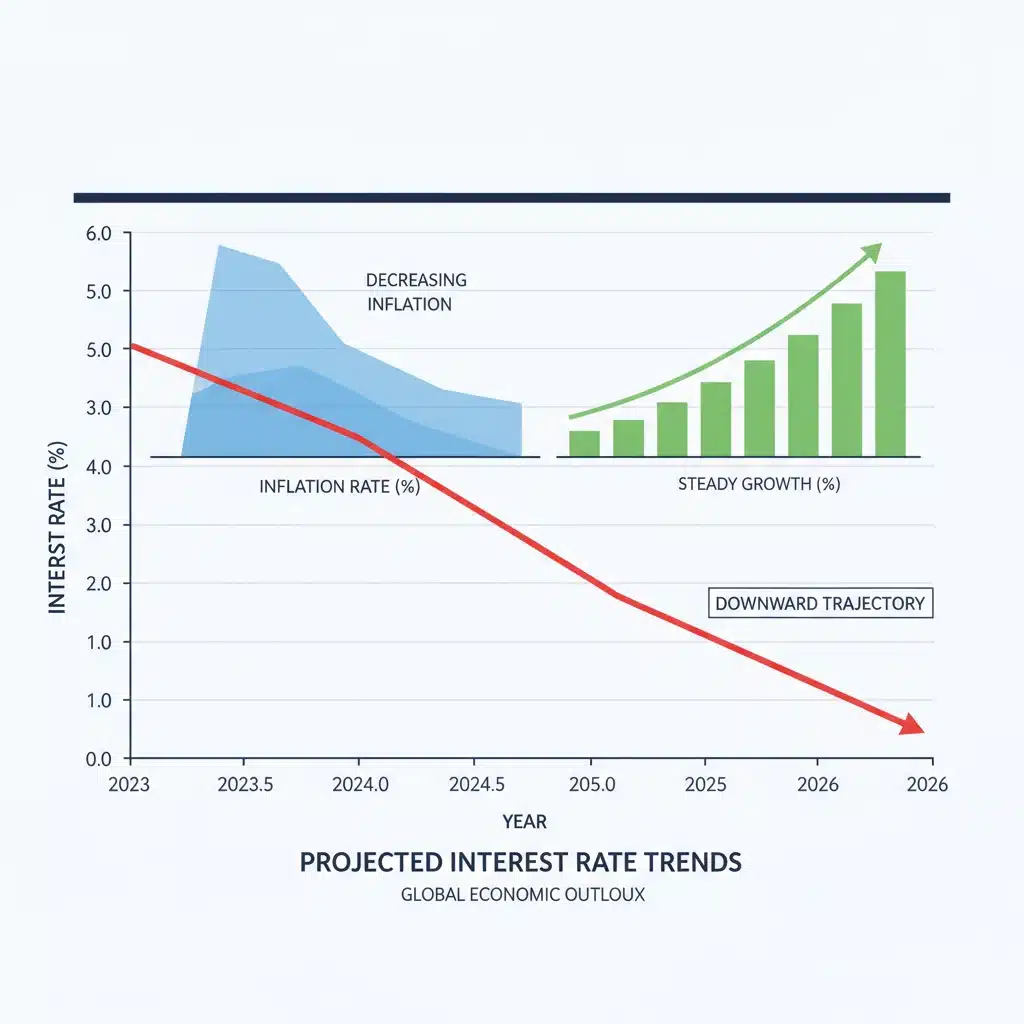
In this optimistic scenario, the Fed successfully brings inflation under control without triggering a severe recession. By 2026, inflation has comfortably settled near the 2% target, and the labor market remains healthy but not overheated. In this environment, the Federal Reserve might have already initiated a gradual process of rate cuts, bringing the federal funds rate back to a more ‘neutral’ level – a rate that neither stimulates nor restricts economic growth. This would imply a more stable and predictable interest rate environment, fostering renewed investment and consumer confidence. This scenario is highly desirable but often challenging to achieve.
Scenario 2: Persistent Inflation and Higher for Longer
This scenario envisions a world where inflation proves more stubborn than anticipated. Perhaps due to renewed supply chain shocks, strong global demand, or persistent wage pressures, inflation remains above the Fed’s target in 2026. In such a situation, the Federal Reserve would likely maintain a ‘higher for longer’ interest rate policy. This means rates would remain elevated, potentially even seeing further modest hikes, to ensure inflation is decisively tackled. Such a strategy would prioritize price stability, but it could come at the cost of slower economic growth and increased borrowing costs for businesses and consumers.
Scenario 3: Economic Downturn and Rate Cuts
Conversely, 2026 could see the economy enter a significant downturn or recession. This could be triggered by the cumulative effect of past rate hikes, a global economic shock, or a domestic financial crisis. In this scenario, the Federal Reserve would swiftly pivot to an accommodative monetary policy, aggressively cutting interest rates to stimulate economic activity, encourage borrowing, and support employment. Quantitative easing, where the Fed purchases assets to inject liquidity, might also be reintroduced. This scenario would reflect a Fed responding to a significant weakening of the economy.
Scenario 4: Stagflationary Environment
A more challenging and less desirable scenario involves stagflation – a combination of high inflation and stagnant economic growth. If the economy experiences persistent supply-side shocks that fuel inflation while simultaneously dampening growth, the Fed would face a difficult dilemma. Raising rates to fight inflation could exacerbate the growth slowdown, while cutting rates to stimulate growth could worsen inflation. In such a complex environment, the Federal Reserve 2026 strategy would likely involve a highly nuanced approach, potentially focusing on supply-side solutions or accepting a trade-off between its dual mandates.
The Economic Impact of Federal Reserve’s 2026 Interest Rate Strategy
Regardless of the specific path the Federal Reserve takes, its interest rate decisions in 2026 will have profound and widespread economic implications.
For Businesses
Businesses will be significantly impacted by the Federal Reserve 2026 strategy. Higher interest rates translate to higher borrowing costs for everything from working capital to expansion projects. This can lead to reduced investment, slower hiring, and potentially lower profits, especially for debt-laden companies. Sectors that are particularly sensitive to interest rates, such as real estate, automotive, and capital-intensive industries, will feel the effects most acutely. Conversely, lower interest rates would encourage investment and expansion, making it cheaper for businesses to borrow and grow.
For Consumers
Consumers will also experience direct and indirect effects. Higher interest rates mean higher costs for mortgages, car loans, credit card debt, and other forms of borrowing. This can reduce disposable income and dampen consumer spending, which is a major driver of economic growth. Savers, however, might benefit from higher interest rates on their deposits. The housing market, in particular, is highly sensitive to interest rate changes, with higher rates typically leading to reduced affordability and slower sales. Lower rates would reverse these trends, making borrowing more affordable and potentially stimulating consumer demand.
For Financial Markets
Financial markets are arguably the most immediate responders to Federal Reserve policy. Stock markets often react negatively to higher rates due to concerns about corporate profitability and economic slowdowns. Bond markets, on the other hand, see yields rise with interest rates, making fixed-income investments more attractive. Currency markets are also affected, as higher interest rates typically strengthen the U.S. dollar, making U.S. exports more expensive and imports cheaper. Investors will need to carefully adjust their portfolios based on the anticipated Federal Reserve 2026 strategy.
For the Global Economy
Given the dollar’s role as the world’s reserve currency, the Federal Reserve’s actions have global ramifications. Higher U.S. interest rates can attract capital away from other countries, potentially weakening their currencies and making it more expensive for them to service dollar-denominated debt. This can create challenges for emerging markets and economies heavily reliant on foreign capital. Conversely, lower U.S. rates can ease these pressures, but also potentially lead to capital outflows from the U.S. to higher-yielding markets elsewhere.
Navigating the Future: Preparation and Adaptability
In light of the potential shifts in the Federal Reserve’s 2026 interest rate strategy, preparation and adaptability will be key for individuals, businesses, and investors alike.
For Individuals
Consumers should review their personal finances, especially debt obligations. If interest rates are expected to rise or remain high, consider locking in fixed-rate loans where possible or paying down variable-rate debt. Building an emergency fund becomes even more crucial in uncertain economic times. For savers, exploring higher-yield savings accounts or certificates of deposit (CDs) might be beneficial.
For Businesses
Businesses should stress-test their financial models against various interest rate scenarios. Diversifying funding sources, managing debt levels prudently, and focusing on operational efficiency can help mitigate the impact of higher borrowing costs. Companies heavily reliant on consumer spending should assess the potential for reduced demand. Those with international operations should also monitor currency fluctuations closely.
For Investors
Investors should consider diversifying their portfolios to withstand different economic conditions. This might involve rebalancing between growth and value stocks, adjusting exposure to fixed-income assets, and exploring alternative investments. Staying informed about economic indicators and Federal Reserve communications will be vital for making timely investment decisions. Long-term investment strategies, however, should ideally remain resilient to short-to-medium term market fluctuations.

The Role of Communication and Transparency
The Federal Reserve’s communication strategy plays a crucial role in managing market expectations and guiding economic behavior. By providing clear guidance on its policy outlook, economic projections, and the rationale behind its decisions, the Fed aims to reduce uncertainty and promote stability. Forward guidance, where the Fed signals its future policy intentions, is a powerful tool in its arsenal. As 2026 approaches, the clarity and consistency of the Fed’s communication will be instrumental in helping markets and the public understand and adapt to its evolving interest rate strategy. Any ambiguity or sudden shifts in communication can lead to market volatility and undermine confidence.
Beyond Interest Rates: Other Tools of the Federal Reserve
While interest rates are the most prominent tool, the Federal Reserve has other instruments at its disposal to influence the economy. Quantitative easing (QE) and quantitative tightening (QT) involve the Fed buying or selling government securities to inject or withdraw liquidity from the financial system. These tools can be deployed alongside interest rate adjustments, especially during periods of extreme economic stress or when interest rates are already at their effective lower bound (near zero). In 2026, depending on the economic conditions, the Fed might lean more heavily on these tools to complement its interest rate policy, particularly if a significant stimulus or contraction is required beyond what interest rate adjustments alone can achieve.
Conclusion: A Future Shaped by Deliberate Policy
The Federal Reserve’s 2026 interest rate strategy will be a critical determinant of the economic environment in the coming years. While predicting the exact path is impossible due to the inherent uncertainties of economic forecasting, understanding the factors that influence the Fed’s decisions and the potential scenarios that could unfold provides a valuable framework for preparation. Whether the Fed navigates a soft landing, maintains a ‘higher for longer’ stance, or is forced to cut rates in response to a downturn, its actions will be deliberate and aimed at achieving its dual mandate of maximum employment and price stability. By staying informed, adapting strategies, and maintaining financial prudence, individuals and businesses can better position themselves to thrive in the evolving economic landscape shaped by the Federal Reserve’s crucial policy choices.
The journey to 2026 will undoubtedly present its own set of challenges and opportunities. The Federal Reserve, with its powerful tools and mandate, will remain a central figure in shaping this journey. Its ability to balance competing objectives, respond effectively to unforeseen shocks, and communicate clearly will be key to fostering a stable and prosperous economic future. Therefore, continuous monitoring of economic data, Fed statements, and expert analysis will be indispensable for anyone seeking to understand and navigate the economic currents of 2026 and beyond.