Navigating 2026 Federal Student Loan Programs: Your Essential Guide

Anúncios
Navigating the Future: Understanding the 2026 Federal Student Loan Programs
The landscape of higher education finance is constantly evolving, and staying ahead of the curve is crucial for prospective students and their families. As we look towards 2026, significant changes and updates to the 2026 Federal Student Loan Programs are on the horizon. These programs are a cornerstone of financial aid for millions, helping to make college dreams a reality. This comprehensive guide aims to demystify these changes, offering a clear roadmap to understanding what you need to know now to prepare for the future of federal student aid.
Whether you’re a high school student planning for college, a current undergraduate or graduate student, or a parent supporting your child’s education, grasping the nuances of the 2026 Federal Student Loan Programs is paramount. From eligibility criteria to application processes, and from loan types to repayment strategies, every detail can impact your financial future. Our goal is to provide you with an in-depth, SEO-optimized resource that covers all essential aspects, ensuring you are well-equipped to make informed decisions regarding your educational funding.
Anúncios
The Evolving Landscape of Federal Student Aid: What’s Changing for 2026?
The federal student loan system is not static; it undergoes periodic revisions to adapt to economic shifts, educational costs, and policy priorities. The 2026 Federal Student Loan Programs are expected to reflect a continuation of recent trends while introducing new adjustments designed to improve accessibility and manageability for borrowers. Understanding these changes is the first step in effective financial planning for higher education.
One of the most significant areas of ongoing reform pertains to the Free Application for Federal Student Aid (FAFSA). While many changes to the FAFSA form itself have been implemented in recent years to simplify the process, further refinements or clarifications may be introduced by 2026. These could include changes to how financial need is calculated, the types of income and assets considered, and the overall user experience of the application. Staying updated on FAFSA requirements is critical, as it is the gateway to all federal student aid, including the 2026 Federal Student Loan Programs.
Anúncios
Beyond the FAFSA, potential shifts in loan interest rates, origination fees, and borrowing limits for various loan types (such as Direct Subsidized Loans, Direct Unsubsidized Loans, and Direct PLUS Loans) could be on the horizon. These adjustments are often tied to federal budget decisions and economic indicators. While specifics for 2026 are still developing, prospective borrowers should be aware that these elements are subject to change and can significantly impact the total cost of borrowing.
Furthermore, there’s an increasing emphasis on accountability and transparency within federal student aid. This could translate into more rigorous reporting requirements for institutions, clearer communication to borrowers about their rights and responsibilities, and enhanced tools for financial literacy. The aim is often to ensure that students are not only able to access funds but also understand the long-term implications of their borrowing decisions within the 2026 Federal Student Loan Programs.
Key Components of the 2026 Federal Student Loan Programs
To navigate the 2026 Federal Student Loan Programs effectively, it’s essential to understand their core components. These programs are designed to provide financial assistance to students pursuing higher education, helping to cover tuition, fees, room and board, books, and other educational expenses. They typically offer more favorable terms than private loans, including fixed interest rates, income-driven repayment options, and potential for loan forgiveness.
Direct Subsidized Loans
These loans are available to undergraduate students with demonstrated financial need. The key benefit of Direct Subsidized Loans is that the U.S. Department of Education pays the interest while you’re in school at least half-time, during your grace period, and during periods of deferment. This significantly reduces the overall cost of borrowing. Eligibility for these loans is determined by your FAFSA information and your school’s financial aid office. It’s often the most advantageous type of federal student loan for eligible students.
Direct Unsubsidized Loans
Direct Unsubsidized Loans are available to undergraduate and graduate students, regardless of financial need. Unlike subsidized loans, interest accrues on Direct Unsubsidized Loans from the moment the loan is disbursed, even while you are in school. You are responsible for all the interest. While you don’t have to make payments on the interest until after you leave school, it’s often wise to pay the interest while you’re in school if you can, to prevent it from capitalizing (being added to your principal balance).
Direct PLUS Loans (Parent PLUS and Grad PLUS)
Direct PLUS Loans are designed for graduate or professional students (Grad PLUS) and parents of dependent undergraduate students (Parent PLUS) to help pay for education expenses not covered by other financial aid. Eligibility for PLUS loans generally requires a credit check. If you have an adverse credit history, you may still be able to obtain a PLUS loan with an endorser who doesn’t have an adverse credit history, or by documenting extenuating circumstances. The interest rates for PLUS loans are typically higher than those for subsidized or unsubsidized loans, and they also accrue interest from disbursement. These loans can be a vital resource for covering funding gaps, but borrowers should approach them with a clear understanding of the repayment obligations.
Perkins Loans (Status for 2026)
It’s important to note that the Federal Perkins Loan Program expired on September 30, 2017, and no new Perkins Loans have been disbursed since then. While previous borrowers continue to repay their Perkins Loans, the 2026 Federal Student Loan Programs will not include new Perkins Loan offerings. This highlights the importance of staying current with program updates, as aid options can change over time.
Eligibility Requirements for 2026 Federal Student Loan Programs
To qualify for the 2026 Federal Student Loan Programs, applicants must meet several fundamental eligibility criteria set by the U.S. Department of Education. These requirements ensure that federal aid is directed to eligible students and institutions.
- U.S. Citizenship or Eligible Non-Citizen: You must be a U.S. citizen or an eligible non-citizen with a valid Social Security number.
- High School Diploma or Equivalent: You must have a high school diploma or a General Education Development (GED) certificate, or have completed homeschooling.
- Enrollment in an Eligible Program: You must be enrolled or accepted for enrollment as a regular student in an eligible degree or certificate program at a school that participates in the federal student aid programs.
- Satisfactory Academic Progress (SAP): You must maintain satisfactory academic progress as defined by your school. This typically means meeting certain GPA requirements and completing a minimum number of credits within a specific timeframe.
- Not in Default on a Federal Student Loan: You cannot be in default on any federal student loan or owe a refund on a federal student grant.
- Selective Service Registration: If you are a male between the ages of 18 and 25, you must be registered with the Selective Service System.
- Drug Conviction: There are specific eligibility restrictions if you have been convicted of a drug-related offense while receiving federal student aid.
It’s crucial to review these requirements carefully and ensure you meet them before applying. Your school’s financial aid office is an invaluable resource for clarifying any questions regarding eligibility for the 2026 Federal Student Loan Programs.
The Application Process: Your Gateway to 2026 Federal Student Loans
The application process for the 2026 Federal Student Loan Programs primarily revolves around completing the Free Application for Federal Student Aid (FAFSA). This form collects your financial and demographic information to determine your eligibility for federal student aid, including grants, work-study, and federal student loans.
Step-by-Step FAFSA Completion:
- Gather Necessary Documents: Before you start, collect your Social Security number, federal income tax returns (and your parents’ if you are a dependent student), W-2 forms, and records of other money earned. You’ll also need bank statements and records of investments (if applicable).
- Create an FSA ID: Both the student and one parent (for dependent students) will need an FSA ID, which is a username and password used to log in to federal student aid websites and sign federal student aid documents electronically.
- Complete the FAFSA Online: Visit the official FAFSA website (studentaid.gov/fafsa) and begin the application. Be sure to use the correct academic year’s FAFSA (e.g., for the 2026-2027 academic year, you would likely fill out the 2026-2027 FAFSA).
- Provide School Codes: List all the colleges and universities you are considering. The FAFSA will send your information to these schools, allowing them to create a financial aid package for you.
- Review and Submit: Carefully review all your answers for accuracy before submitting the FAFSA. Errors can delay your aid processing.
- Receive Your Student Aid Report (SAR): After submission, you’ll receive a Student Aid Report (SAR) which summarizes your FAFSA data. Review it for any mistakes and make corrections if needed.
The FAFSA opens annually on October 1st for the following academic year. While the federal deadline is often later, many states and individual colleges have earlier deadlines for state and institutional aid. Therefore, it is highly recommended to complete the FAFSA as early as possible to maximize your chances of receiving all available aid, including the 2026 Federal Student Loan Programs.

The Role of Your School’s Financial Aid Office
Once your FAFSA is processed, your chosen schools will receive your information and determine your eligibility for various aid programs. They will then send you an award letter detailing the financial aid package they are offering, which may include federal grants, scholarships, work-study, and federal student loans. Your school’s financial aid office is your primary point of contact for understanding your specific aid package, accepting or declining loans, and navigating any institutional-specific requirements related to the 2026 Federal Student Loan Programs.
Understanding Interest Rates and Fees for 2026 Federal Student Loans
When considering the 2026 Federal Student Loan Programs, it’s crucial to understand how interest rates and fees impact the total cost of your borrowing. Federal student loans generally offer fixed interest rates, meaning the rate won’t change over the life of the loan. This provides predictability in your repayment plan.
Interest Rate Determination
Federal student loan interest rates are set annually by Congress. They are typically based on the 10-year Treasury note auction, plus a statutory add-on amount. The rates are fixed for the life of the loan once disbursed. While we don’t know the exact rates for 2026 yet, they are usually announced in late spring or early summer for loans disbursed for the upcoming academic year (e.g., for the 2026-2027 academic year). It’s important to monitor official Department of Education announcements for the specific rates that will apply to the 2026 Federal Student Loan Programs.
Historically, Direct Subsidized and Unsubsidized Loans for undergraduates have the lowest rates, followed by Direct Unsubsidized Loans for graduate students, and then Direct PLUS Loans for parents and graduate students which tend to have the highest rates among federal options.
Origination Fees
In addition to interest, most federal student loans carry an origination fee. This fee is a small percentage of the total loan amount and is deducted proportionally from each loan disbursement. This means the amount you receive will be slightly less than the amount you actually borrow. For instance, if you borrow $10,000 with a 1% origination fee, you would receive $9,900. These fees are also subject to change by congressional action and are typically updated annually. Be sure to factor these fees into your budgeting when planning with the 2026 Federal Student Loan Programs.
Understanding both the interest rates and origination fees will give you a more accurate picture of the true cost of your federal student loans and help you make informed borrowing decisions.
Repayment Options and Strategies for 2026 Federal Student Loans
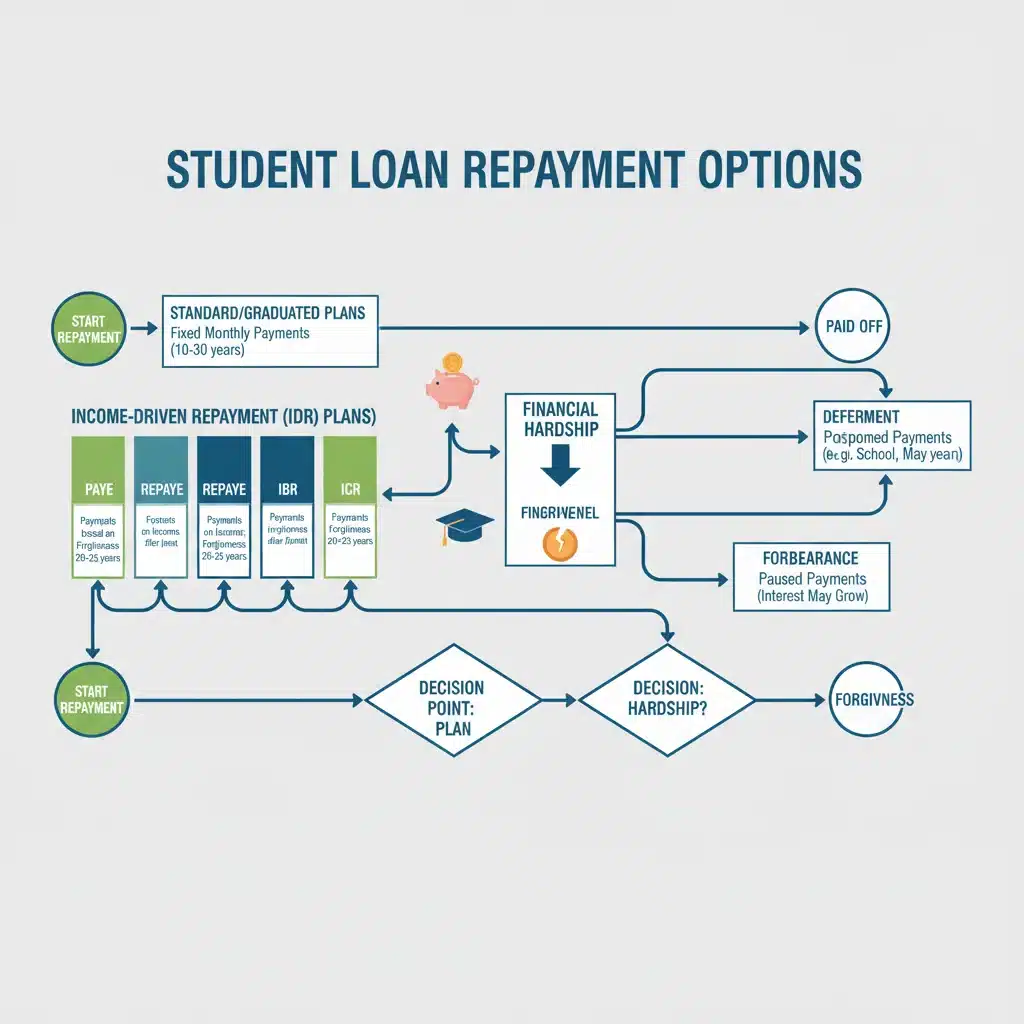
One of the most significant advantages of 2026 Federal Student Loan Programs compared to private loans is the wide array of flexible repayment options available. These options are designed to help borrowers manage their debt effectively, especially during periods of financial hardship.
Standard Repayment Plan
This is the default plan, where you pay a fixed amount each month for up to 10 years (or up to 30 years for consolidated loans). While it results in the lowest total interest paid over the life of the loan, the monthly payments can be higher than other plans.
Graduated Repayment Plan
Under this plan, payments start low and gradually increase, typically every two years. This can be beneficial if you expect your income to rise over time. The repayment period is also up to 10 years.
Extended Repayment Plan
If you have more than $30,000 in federal student loans, you may be eligible for an extended repayment plan, which allows you to make fixed or graduated payments for up to 25 years. This lowers your monthly payment but increases the total interest paid.
Income-Driven Repayment (IDR) Plans
IDR plans are particularly valuable for borrowers whose incomes are low compared to their student loan debt. Payments are calculated based on your income and family size, and they are generally recalculated each year. There are several IDR plans, including:
- Revised Pay As You Earn (REPAYE) Plan: Generally 10% of your discretionary income.
- Pay As You Earn (PAYE) Plan: Generally 10% of your discretionary income, but never more than the 10-year Standard Repayment Plan amount.
- Income-Based Repayment (IBR) Plan: Generally 10% or 15% of your discretionary income, depending on when you received your first loans.
- Income-Contingent Repayment (ICR) Plan: The lesser of 20% of your discretionary income or what you would pay on a fixed 12-year payment plan, adjusted for income.
A significant benefit of IDR plans is that any remaining loan balance is forgiven after 20 or 25 years of payments, depending on the plan and the type of loans. However, the forgiven amount may be considered taxable income by the IRS, so it’s important to consult with a tax professional.
Forbearance and Deferment
These options allow you to temporarily postpone or reduce your loan payments if you’re experiencing financial hardship, unemployment, or are enrolled in school. While deferment can sometimes halt interest accrual (for subsidized loans), forbearance typically allows interest to accrue on all loan types, which can increase your total loan cost. These should generally be considered short-term solutions.
Public Service Loan Forgiveness (PSLF)
For borrowers working full-time for a qualifying government or non-profit organization, PSLF offers forgiveness of the remaining balance on Direct Loans after 120 qualifying monthly payments have been made under a qualifying repayment plan (typically an IDR plan). This program can be incredibly beneficial for those committed to public service careers.
Choosing the right repayment plan for your 2026 Federal Student Loan Programs will depend on your income, career path, and financial goals. The studentaid.gov website offers a Loan Simulator tool that can help you compare different plans and estimate your monthly payments and total costs.
Future-Proofing Your Financial Aid Strategy for 2026 and Beyond
Preparing for the 2026 Federal Student Loan Programs involves more than just understanding the current rules; it requires a proactive approach to your entire financial aid strategy. By implementing smart planning now, you can optimize your borrowing and minimize future financial stress.
Maximize Free Aid First
Before considering any loans, prioritize applying for scholarships and grants. These are forms of ‘gift aid’ that do not need to be repaid. Explore institutional scholarships, private scholarships, and state grants. Every dollar you receive in free aid is a dollar you don’t have to borrow from the 2026 Federal Student Loan Programs.
Borrow Only What You Need
It can be tempting to borrow the maximum amount offered, but resist this urge. Carefully calculate your actual educational expenses and borrow only the amount necessary to cover the gap after other aid. Every dollar borrowed accrues interest, so less principal means less interest paid over time.
Understand Your Loan Terms
Before accepting any loan from the 2026 Federal Student Loan Programs, thoroughly read and understand the terms and conditions. Pay attention to interest rates, origination fees, and repayment start dates. Knowledge is power when it comes to managing debt.
Maintain Good Academic Standing
As mentioned, maintaining Satisfactory Academic Progress (SAP) is a requirement for continued federal student aid eligibility. Failing to meet SAP could jeopardize your access to federal loans and other aid, forcing you to seek more expensive private alternatives or even drop out.
Consider a Budget and Financial Literacy
Develop a realistic budget that accounts for all your expenses, including loan repayments. Improving your financial literacy will empower you to make better financial decisions throughout your academic career and beyond. Many universities offer financial counseling services that can be incredibly helpful.
Stay Informed About Policy Changes
The landscape of federal student aid is dynamic. Regularly check the official U.S. Department of Education website (studentaid.gov) and news sources for updates regarding the 2026 Federal Student Loan Programs and other financial aid policies. Subscribing to newsletters from reputable financial aid organizations can also keep you informed.
Communicate with Your School’s Financial Aid Office
Your school’s financial aid office is your best resource. If you encounter unexpected financial difficulties, or have questions about your aid package, repayment options, or eligibility, reach out to them promptly. They can provide personalized guidance and help you explore solutions.
Common Misconceptions About Federal Student Loans
Dispelling common myths about the 2026 Federal Student Loan Programs is vital for making sound financial decisions.
- Myth: All student loans are the same.
Reality: Federal loans offer protections and benefits (like income-driven repayment and forgiveness programs) that private loans generally do not. Understanding the distinction is crucial. - Myth: You can’t get federal aid if your parents make too much money.
Reality: While income affects need-based aid like Direct Subsidized Loans and Pell Grants, many federal loans (like Direct Unsubsidized Loans and PLUS Loans) are available regardless of income. Everyone should fill out the FAFSA. - Myth: You don’t have to pay back student loans if you don’t graduate.
Reality: Student loans, federal or private, must be repaid regardless of whether you complete your degree. - Myth: Student loan debt can be discharged in bankruptcy.
Reality: While technically possible, discharging student loans in bankruptcy is extremely difficult and rare, requiring proof of ‘undue hardship.’ - Myth: Interest rates are always the same.
Reality: Federal loan interest rates are fixed for the life of the loan but are set annually by Congress, meaning rates for loans disbursed in 2026 could differ from those in 2025.
By understanding the facts, you can approach the 2026 Federal Student Loan Programs with confidence and clarity.
Author