Voice Commerce 2026: Key Consumer Behaviors & Future Trends

Anúncios
The Future of Voice Commerce: 3 Key Consumer Behaviors to Watch in 2026 (RECENT UPDATES)
The retail landscape is in a perpetual state of flux, constantly reshaped by technological advancements and evolving consumer expectations. Among the most transformative forces emerging in recent years is voice commerce, a domain poised for exponential growth. By 2026, voice-activated shopping is not just a novelty; it will be an integral part of daily life for millions, fundamentally altering how consumers interact with brands and make purchasing decisions. Understanding the core voice commerce behaviors that will define this era is paramount for any business looking to stay competitive and relevant.
The shift towards voice commerce is driven by a confluence of factors, including the proliferation of smart speakers and voice assistants, advancements in natural language processing (NLP), and a growing consumer desire for convenience and hands-free interactions. As we approach 2026, the initial curiosity surrounding voice technology has matured into a more sophisticated adoption, where users are not just asking for weather updates but are confidently managing their shopping lists, reordering essentials, and even making complex purchases through spoken commands. This article delves into three crucial consumer behaviors that will dominate the voice commerce landscape by 2026, offering recent updates and actionable insights for businesses.
Voice commerce behaviors are becoming increasingly nuanced, moving beyond simple commands to more complex, conversational interactions. This evolution demands a strategic recalibration from businesses, requiring them to optimize their digital presence for voice search, personalize recommendations, and ensure a seamless, secure, and satisfying voice-activated shopping experience. The early adopters of voice commerce have already laid the groundwork, and now, as the technology becomes more ubiquitous, understanding these behaviors will be the key to unlocking significant market share.
Anúncios
1. The Rise of Hands-Free, Frictionless Shopping Experiences
One of the most significant voice commerce behaviors to observe by 2026 is the pervasive demand for hands-free, frictionless shopping. Consumers are increasingly time-poor and seek efficiency in every aspect of their lives. Voice commands offer an unparalleled level of convenience, allowing individuals to shop while multitasking – whether they are cooking, driving, exercising, or simply relaxing on the couch. This isn’t just about speed; it’s about eliminating physical barriers and cognitive load associated with traditional online shopping interfaces.
Recent Updates: The development of more sophisticated AI assistants capable of understanding complex queries and maintaining context across multiple interactions has accelerated this trend. Voice assistants are no longer just command-response tools; they are becoming proactive shopping companions. For instance, an assistant might suggest reordering a frequently purchased item when stock is low, or recommend complementary products based on past purchases and current inventory. This proactive engagement reduces the need for consumers to actively search, further streamlining the shopping process.
Anúncios
The Convenience Imperative: Why Hands-Free Matters
The convenience offered by hands-free shopping extends beyond just saving time. It caters to a fundamental human desire for ease and simplicity. Imagine a parent busy with children, able to add items to their grocery list with a simple voice command, or a professional reordering office supplies without interrupting their workflow. This is the promise of voice commerce, and by 2026, it will be a standard expectation, not a luxury.
- Multitasking Mastery: Voice allows consumers to shop while engaged in other activities, maximizing their productivity and minimizing interruptions.
- Accessibility: For individuals with disabilities or those who find traditional interfaces challenging, voice commerce offers a more accessible pathway to purchasing goods and services.
- Reduced Cognitive Load: Eliminating the need to navigate complex websites or type out search queries frees up mental resources, making the shopping experience less strenuous.
Businesses must, therefore, prioritize optimizing their product catalogs and descriptions for voice search. This means focusing on natural language, common phrases, and long-tail keywords that consumers are likely to use in conversational queries. Furthermore, the checkout process must be exceptionally streamlined, ideally requiring minimal verbal confirmation to complete a purchase, leveraging pre-saved payment methods and delivery addresses.
The emphasis on frictionless experiences also extends to returns and customer service. Voice assistants that can effortlessly handle order status inquiries, initiate returns, or connect users with support agents will significantly enhance customer satisfaction and loyalty. The less effort a customer has to expend, the more likely they are to embrace and consistently use voice commerce for their shopping needs.
2. Hyper-Personalization and Proactive Recommendations
Another critical aspect of evolving voice commerce behaviors by 2026 is the expectation of hyper-personalization and proactive recommendations. Consumers are increasingly accustomed to personalized experiences in their digital lives, from streaming services suggesting movies to social media feeds tailored to their interests. Voice commerce takes this a step further, leveraging the intimate nature of voice interactions and the wealth of data available to offer highly relevant and timely suggestions.
Recent Updates: AI algorithms are becoming incredibly adept at understanding individual preferences, purchase history, and even subtle cues in voice patterns to anticipate needs. Beyond simple product recommendations, voice assistants are now capable of curating entire shopping experiences based on a user’s lifestyle, dietary restrictions, brand loyalties, and even their current mood. Imagine a voice assistant suggesting a healthy meal kit based on your recent fitness goals and available ingredients in your smart fridge, or recommending a new book by your favorite author the moment it’s released.

The Power of Predictive Analytics in Voice Commerce
The ability to predict consumer needs before they are explicitly stated is a game-changer. This predictive power is fueled by advanced analytics that combine historical purchase data, real-time context (like location or time of day), and even external factors (like weather or trending events). For businesses, this translates into an unprecedented opportunity to engage with customers in a deeply meaningful and value-driven way.
- Contextual Awareness: Voice assistants will leverage data from connected devices (smart home, wearables) to understand the user’s environment and provide highly relevant recommendations.
- Anticipatory Shopping: Replenishment services will become standard, with voice assistants automatically reordering household staples or suggesting subscriptions based on consumption patterns.
- Curated Experiences: Beyond individual products, voice will facilitate the creation of entire personalized shopping lists or even meal plans, simplifying complex decision-making.
To capitalize on this, businesses need robust data infrastructure and sophisticated AI capabilities. This involves integrating customer data across all touchpoints, from online purchases to in-store interactions, and using machine learning to identify patterns and predict future needs. The language used in recommendations must also be natural and non-intrusive, feeling more like a helpful suggestion from a trusted advisor than a sales pitch.
Furthermore, building trust will be crucial. Consumers must feel confident that their data is being used responsibly and that personalization is genuinely for their benefit. Transparency about data usage and clear opt-in/opt-out mechanisms will be essential for fostering long-term relationships in this highly personalized voice commerce ecosystem.
3. Enhanced Security and Trust in Voice Transactions
As voice commerce becomes more prevalent, consumer concerns around security and trust will also escalate. By 2026, one of the most critical voice commerce behaviors will be the expectation of robust security measures and a high level of trust in voice-activated transactions. Early anxieties about unauthorized purchases or data breaches will necessitate advanced authentication methods and transparent privacy policies to ensure widespread adoption.
Recent Updates: Biometric voice authentication, often combined with other factors like PINs or facial recognition on accompanying smart displays, is becoming more sophisticated. AI is also being used to detect anomalies in voice patterns that might indicate fraud. Furthermore, major platforms are investing heavily in encryption and secure protocols for payment processing through voice. The industry is moving towards a multi-layered security approach, making voice transactions as secure, if not more secure, than traditional online payments.
Building Unwavering Trust in Voice Commerce
Trust is the bedrock of any commercial relationship, and in the nascent world of voice commerce, it is even more critical. Consumers need reassurance that their financial information is safe, their privacy is protected, and their voice commands are accurately interpreted and executed. Without this foundational trust, widespread adoption of voice commerce will remain elusive.
- Biometric Authentication: Voice biometrics will become a standard for verifying user identity, providing a seamless yet secure layer of protection.
- Transparent Privacy Policies: Clear, easy-to-understand explanations of how voice data is collected, stored, and used will be essential for consumer confidence.
- Confirmation Protocols: For high-value purchases, verbal confirmation, PIN entry, or even a visual confirmation on a paired device will be standard to prevent accidental or unauthorized transactions.
Businesses entering or expanding within the voice commerce space must prioritize investing in state-of-the-art security infrastructure. This includes end-to-end encryption for all voice data, secure payment gateways, and robust fraud detection systems. Collaborating with leading security providers and adhering to industry best practices will be crucial.
Beyond technical security, building trust also involves clear communication. Brands need to educate consumers about the security features of their voice commerce offerings and provide readily accessible support for any concerns. A negative security incident can severely erode consumer confidence and set back the adoption of voice commerce for an entire industry. Therefore, proactive communication and robust incident response plans are non-negotiable.
The Broader Implications of Evolving Voice Commerce Behaviors
The three key voice commerce behaviors discussed – hands-free shopping, hyper-personalization, and enhanced security – are not isolated trends. They are interconnected and collectively paint a picture of a future where voice-activated commerce is intuitive, efficient, and deeply integrated into daily life. For businesses, this means a paradigm shift in how they approach digital strategy, customer engagement, and technological investment.
Rethinking the Customer Journey for Voice
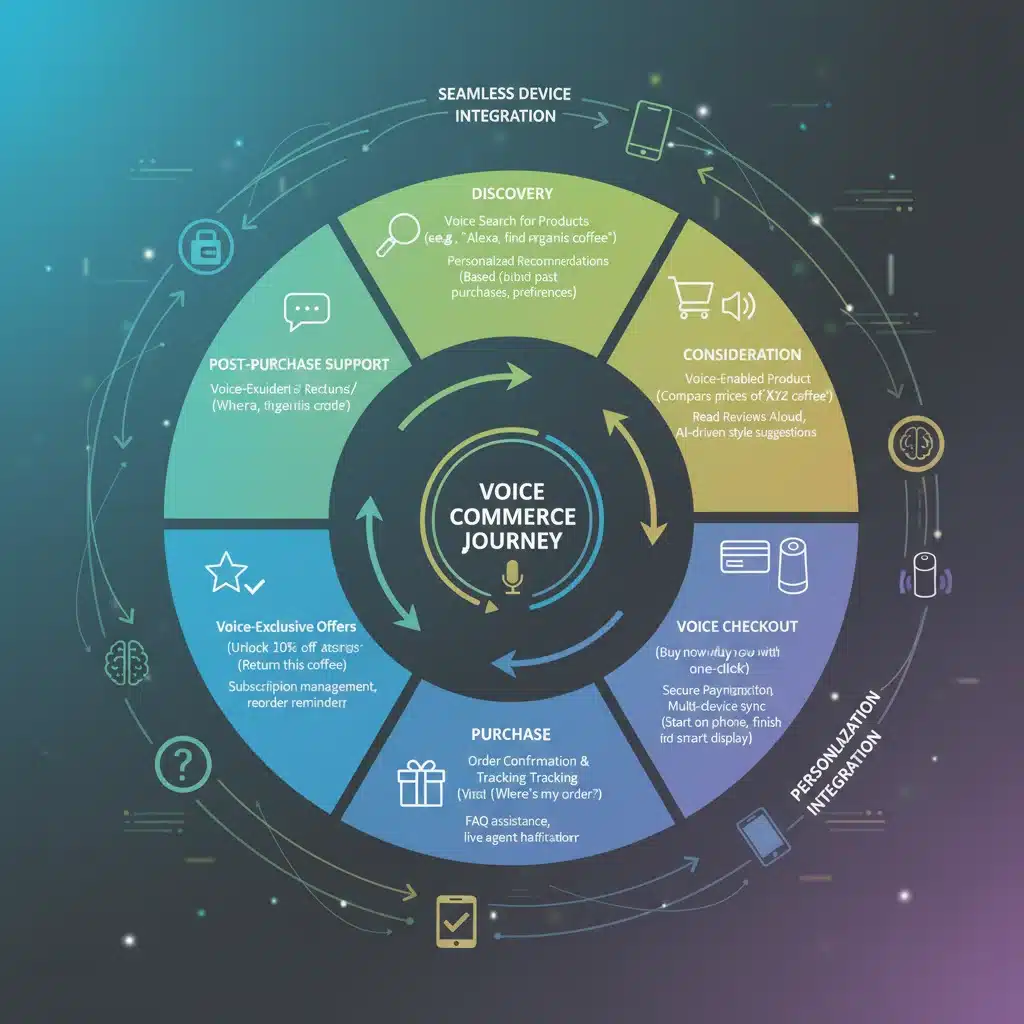
The traditional customer journey, often visualized as a linear path, becomes more fluid and conversational in a voice commerce environment. Discovery might happen through a casual query, consideration through proactive suggestions, and purchase through a simple verbal confirmation. Businesses need to map out these new voice-centric customer journeys, identifying key touchpoints and optimizing for spoken interactions rather than clicks and scrolls.
This involves developing a ‘voice-first’ mindset in product development and marketing. How would a customer ask for this product? What information would they need? How can the purchasing process be simplified to a few natural language exchanges? These questions will drive innovation in voice commerce.
The Role of Brand Voice and Personality
In a world where interactions are increasingly conversational, the ‘voice’ of a brand takes on new meaning. The tone, personality, and responsiveness of a brand’s voice assistant can significantly influence consumer perception and loyalty. A helpful, empathetic, and efficient voice assistant can become a trusted brand ambassador, while a clunky or unresponsive one can quickly alienate customers.
Investing in natural language understanding (NLU) and natural language generation (NLG) is crucial here. Brands need to ensure their voice experiences are not just functional but also engaging and consistent with their overall brand identity. This could involve developing unique voice assistant personalities or integrating brand-specific jargon and messaging seamlessly into voice interactions.
Data Ethics and Responsible AI
As voice commerce relies heavily on personal data for personalization, ethical considerations and responsible AI practices become paramount. Businesses must ensure they are transparent about data collection and usage, respect user privacy, and implement safeguards against bias in AI algorithms. Building a reputation as a trustworthy and ethical voice commerce provider will be a significant competitive advantage by 2026.
Consumers are becoming more aware of their data rights, and businesses that fail to uphold ethical standards risk alienating their customer base. Proactive measures, such as offering granular control over data sharing and regularly auditing AI systems for fairness and transparency, will be essential for long-term success.
Integration with the IoT Ecosystem
The future of voice commerce is inextricably linked to the Internet of Things (IoT). As smart homes, connected cars, and wearable devices become more ubiquitous, the opportunities for voice-activated shopping will expand exponentially. Imagine ordering groceries from your smart fridge, buying movie tickets from your car, or purchasing fitness gear based on recommendations from your smartwatch.
Businesses should explore partnerships and integrations with leading IoT platforms and device manufacturers. Creating seamless experiences across different devices and environments will be key to capturing a larger share of the voice commerce market. The ability to start a shopping task on one device and complete it on another, all through voice, will define the next generation of frictionless commerce.
Challenges and Opportunities Ahead for Voice Commerce
While the trajectory for voice commerce is overwhelmingly positive, there are still challenges to navigate. Overcoming these will unlock even greater opportunities for businesses. One major challenge is the continued refinement of natural language understanding to handle diverse accents, dialects, and complex conversational nuances. Another is ensuring interoperability across different voice assistant platforms, so consumers have a consistent experience regardless of their preferred device.
However, the opportunities far outweigh the challenges. The potential for personalized, convenient, and deeply integrated shopping experiences is immense. Early movers who invest in understanding and adapting to these evolving voice commerce behaviors will be well-positioned to capture significant market share and build lasting customer relationships.
The global voice commerce market is projected to reach staggering figures in the coming years, underscoring the urgency for businesses to develop a comprehensive voice strategy. This isn’t just about adding a voice interface; it’s about fundamentally rethinking the customer experience from a conversational perspective. From optimizing product descriptions for spoken queries to developing sophisticated AI-driven recommendation engines and ensuring robust security protocols, every aspect of the digital commerce ecosystem needs to be re-evaluated through the lens of voice.
Conclusion: Embracing the Voice Commerce Revolution by 2026
The landscape of retail is undergoing a profound transformation, with voice commerce emerging as a dominant force. By 2026, the three key consumer behaviors outlined – the demand for hands-free, frictionless shopping; the expectation of hyper-personalization and proactive recommendations; and the necessity of enhanced security and trust in transactions – will define success in this burgeoning market. Businesses that proactively address these trends, investing in robust technology, ethical data practices, and a voice-first approach, will be at the forefront of this revolution.
The future of shopping is conversational, intuitive, and deeply integrated into our daily lives. Understanding and adapting to these evolving voice commerce behaviors is not merely an option but a strategic imperative. The time to prepare for this voice-activated future is now, ensuring that your brand is not just heard, but truly understood and valued by the consumers of tomorrow.
Author