
Maximizing Your Education ROI: Choosing US Degree Programs with a Proven 10-Year Earning Advantage
Investing in higher education is one of the most significant decisions an individual can make. In the United States, the cost of tuition, fees, and living expenses continues to rise, making it imperative for prospective students and their families to consider the return on investment (ROI). This isn’t just about getting a degree; it’s about securing a financially stable and rewarding future. The concept of education ROI US has become a critical factor in selecting a major and institution. This comprehensive guide will delve into the degree programs that consistently offer a proven 10-year earning advantage, helping you make an informed decision about your academic and professional path.
Understanding education ROI US goes beyond immediate post-graduation salaries. It encompasses the long-term financial benefits, career growth potential, and overall job satisfaction derived from a particular field of study. While passion and personal interest are vital, a strategic approach to choosing a major can significantly impact your financial well-being over the next decade and beyond. We will explore various fields, analyze data-driven insights, and provide actionable advice to help you navigate this complex landscape.
Anúncios
The Importance of 10-Year Earning Data in Education Decisions
When evaluating the value of a degree, many focus solely on starting salaries. However, this narrow view can be misleading. A more robust and reliable indicator of a degree’s financial efficacy is its 10-year earning potential. This metric provides a clearer picture of sustained career growth, salary progression, and the true long-term value of your educational investment. Programs that show a strong 10-year earning advantage often indicate fields with high demand, significant skill development, and opportunities for advancement.
Why 10 years? The first few years out of college can be a period of entry-level positions and foundational learning. By the 10-year mark, graduates typically have gained substantial experience, potentially moved into management roles, or specialized further in their fields. This timeframe reflects a more mature stage of a career, where the true impact of their educational foundation becomes evident. Analyzing this data helps prospective students identify degrees that not only offer a good start but also promise a trajectory of increasing financial returns. Therefore, focusing on education ROI US over a decade is a much more strategic approach to higher education planning.
Top-Performing STEM Fields for High Education ROI in the US
It’s no secret that Science, Technology, Engineering, and Mathematics (STEM) fields consistently dominate discussions around high earning potential. Within STEM, certain disciplines stand out for their exceptional 10-year earning advantage. These fields are often at the forefront of innovation, driving economic growth and creating a constant demand for skilled professionals. Let’s explore some of the top contenders.
Anúncios
Engineering Disciplines: The Foundation of Innovation
Engineering remains a powerhouse for high salaries and robust career paths. Within this broad category, several specializations consistently deliver impressive education ROI US:
- Petroleum Engineering: Often at the very top of earning lists, petroleum engineers design and develop methods for extracting oil and gas. While the industry can be cyclical, the specialized skills command premium salaries, often exceeding $150,000 annually after 10 years.
- Computer Engineering/Science: In our increasingly digital world, computer engineers and scientists are indispensable. From software development to cybersecurity, data science, and artificial intelligence, these fields offer continuous innovation and high demand. A 10-year veteran in these roles can easily command six-figure salaries, with many reaching well over $130,000 to $140,000, and even higher in tech hubs.
- Aerospace Engineering: Designing aircraft, spacecraft, satellites, and missiles is a highly specialized and critical field. The complexity and precision required ensure that aerospace engineers are well-compensated, with 10-year earnings frequently surpassing $120,000 to $130,000.
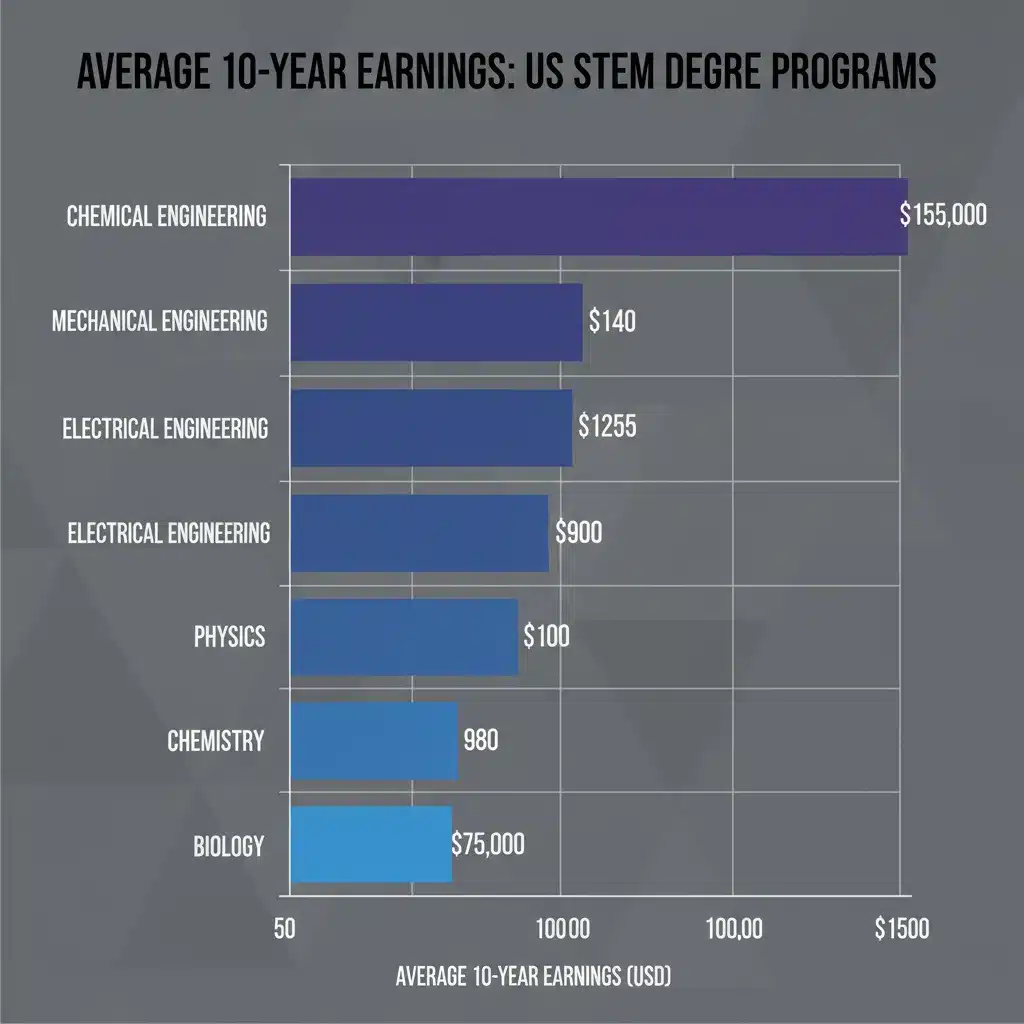
- Chemical Engineering: These engineers apply principles of chemistry, biology, physics, and math to solve problems involving the production or use of chemicals, fuel, drugs, food, and many other products. Their versatile skills are valued across numerous industries, leading to strong long-term earning potential, often above $115,000 after a decade.
- Electrical Engineering: Essential for virtually every industry, electrical engineers work with electricity, electronics, and electromagnetism. Their expertise is crucial for everything from power generation to telecommunications and consumer electronics, ensuring strong and stable career growth with 10-year earnings often around $110,000 to $120,000.
Computer and Information Sciences: The Digital Goldmine
Beyond general computer science, several specific areas within this domain offer exceptional education ROI US:
- Data Science and Analytics: The ability to collect, analyze, and interpret large datasets is one of the most sought-after skills in today’s economy. Data scientists are crucial for business intelligence, product development, and strategic decision-making. Their 10-year earnings are consistently high, often in the range of $120,000 to $150,000, depending on specialization and industry.
- Cybersecurity: With the increasing threat of cyberattacks, cybersecurity professionals are in extremely high demand. Protecting sensitive information and systems is a critical function for every organization. Experts in this field can expect significant salary growth, often exceeding $125,000 after 10 years.
- Software Development: While broad, specializing in specific programming languages, platforms, or areas like mobile app development or cloud computing can lead to outstanding long-term earnings. Experienced software developers are the backbone of the tech industry, with 10-year salaries frequently over $110,000 to $130,000.
Health Professions: Stable Demand and High Rewards
Healthcare is another sector that consistently offers high education ROI US, primarily due to the essential nature of its services and the specialized training required. Many health professions necessitate advanced degrees, but the long-term financial rewards often justify the investment.
Medical and Allied Health Fields: Essential and Lucrative
- Medicine (Physicians and Surgeons): While requiring extensive education and residency, becoming a doctor offers one of the highest lifetime earning potentials. After 10 years in practice, physicians and surgeons can expect average salaries well into the six figures, often exceeding $200,000 to $300,000, depending on specialization.
- Dentistry: Similar to medicine, dentistry requires significant schooling but offers excellent financial returns. Experienced dentists often earn upwards of $180,000 to $250,000 annually.
- Pharmacy: Pharmacists play a crucial role in patient care, dispensing medications and providing expert advice. With a Pharm.D. degree, pharmacists can expect strong and stable earnings, typically ranging from $120,000 to $140,000 after a decade.
- Nursing (Nurse Practitioners, CRNAs): While registered nursing offers good pay, advanced practice registered nurses (APRNs) like Nurse Practitioners (NPs) and Certified Registered Nurse Anesthetists (CRNAs) command significantly higher salaries. CRNAs, in particular, are among the highest-paid nursing professionals, often earning over $180,000 after 10 years. NPs also see excellent growth, reaching $110,000 to $130,000.
- Physical Therapy: As the population ages and awareness of rehabilitation grows, physical therapists are in high demand. A Doctor of Physical Therapy (DPT) degree leads to a rewarding career with 10-year earnings often around $90,000 to $110,000.
Business and Finance: Strategic Acumen for High Returns
For those with a knack for strategy, leadership, and numbers, certain business and finance degrees offer excellent education ROI US. While not always as high as top STEM or medical fields, these programs provide versatile skills applicable across industries and can lead to significant leadership roles.
Specialized Business Degrees: Beyond the General MBA
- Finance (Quantitative Finance/Financial Engineering): These highly specialized finance programs combine advanced mathematics, computer science, and financial theory. Graduates are sought after in investment banking, hedge funds, and risk management. Their 10-year earnings can be exceptionally high, often surpassing $150,000 to $200,000, especially in major financial hubs.
- Accounting (CPA track): While perhaps not as flashy, a career in accounting, especially with a Certified Public Accountant (CPA) license, offers remarkable stability and consistent growth. Experienced accountants and auditors often earn over $90,000 to $120,000, with those in forensic accounting or high-level corporate roles earning more.
- Information Systems Management: Blending business acumen with technology expertise, this field focuses on managing IT resources and systems to achieve organizational goals. These professionals are critical for digital transformation and can expect 10-year earnings in the range of $100,000 to $130,000.
- Supply Chain Management/Logistics: With the complexities of global trade and e-commerce, efficient supply chain management is more critical than ever. Professionals in this area optimize operations, reduce costs, and improve efficiency, leading to strong demand and 10-year earnings often around $95,000 to $120,000.
Factors Influencing Your Education ROI
While the choice of major is paramount, several other factors significantly influence your overall education ROI US. Understanding these elements can further refine your decision-making process and optimize your investment.
Institution Prestige and Location
Attending a highly-ranked university, particularly in fields like engineering or computer science, can open doors to better job opportunities and higher starting salaries. Prestigious institutions often have stronger alumni networks, better career services, and more connections with top employers. Similarly, the geographic location of your university and where you choose to work after graduation play a huge role. Tech hubs like Silicon Valley, financial centers like New York, and major medical research areas offer higher salaries and more opportunities, even for similar degrees.
Internships and Experiential Learning
Hands-on experience through internships, co-op programs, and research opportunities is invaluable. Students who graduate with relevant work experience are often more marketable, command higher salaries, and have a smoother transition into their careers. These experiences can significantly boost your 10-year earning potential by accelerating your career progression.
Advanced Degrees and Certifications
For many of the highest-paying professions, a bachelor’s degree is just the beginning. Pursuing a master’s, doctorate, or professional certification (e.g., CPA, CFA, PMP) can dramatically increase your earning power and career advancement opportunities. While this adds to the initial educational investment, the enhanced education ROI US over a 10-year period often makes it worthwhile.
Networking and Soft Skills
Beyond technical knowledge, developing strong soft skills such as communication, teamwork, problem-solving, and adaptability is crucial. Networking with peers, professors, and industry professionals can lead to mentorship opportunities, job referrals, and career-long support. These intangible assets significantly contribute to career success and, consequently, your long-term earnings.

Navigating the Decision-Making Process
Choosing a degree program that offers a strong education ROI US requires careful consideration and research. Here’s a structured approach to help you make the best decision:
1. Self-Assessment: Interests, Aptitudes, and Values
Before diving into salary data, reflect on your interests, strengths, and what you value in a career. While financial return is important, sustainable career satisfaction often comes from aligning your work with your passions and aptitudes. Are you drawn to problem-solving? Do you enjoy working with people? Are you analytical or creative? Identifying these core aspects will help narrow down fields where you’re likely to excel and remain engaged.
2. Thorough Research: Data-Driven Insights
Utilize reliable resources such as the Bureau of Labor Statistics (BLS), university career services reports, and reputable salary aggregators (e.g., PayScale, Glassdoor, Indeed) to gather specific 10-year earning data for various majors and career paths. Look beyond national averages to consider regional variations and industry-specific trends. Pay attention to job growth projections, as high demand often correlates with higher salaries and better job security.
3. Informational Interviews and Mentorship
Connect with professionals currently working in fields that interest you. Informational interviews can provide invaluable insights into day-to-day responsibilities, career challenges, and growth opportunities. Ask about their educational paths, what they would do differently, and what skills are most important for success in their roles. Mentors can offer guidance and open doors to networking opportunities.
4. Consider the Cost of Education
The total cost of your education – including tuition, fees, living expenses, and potential student loan interest – directly impacts your education ROI US. Compare financial aid packages, scholarship opportunities, and the overall debt burden associated with different institutions and programs. A high-earning degree from an expensive private university might still offer a strong ROI, but it’s crucial to factor in the debt repayment timeline.
5. Flexibility and Adaptability
The job market is constantly evolving. Choose a degree program that provides a strong foundational skillset and encourages adaptability. Fields like computer science, engineering, and data science are continuously innovating, requiring professionals to learn new technologies and methodologies. A degree that equips you with critical thinking, problem-solving, and continuous learning abilities will serve you well for decades.
Beyond the Numbers: Intangible Returns on Investment
While this guide emphasizes financial education ROI US, it’s crucial to acknowledge the intangible benefits of higher education. These non-monetary returns contribute significantly to a fulfilling life and can indirectly impact your earning potential:
- Personal Growth: Higher education fosters critical thinking, intellectual curiosity, and personal development.
- Social Capital: A college environment provides opportunities to build a diverse network of friends and professional contacts.
- Job Satisfaction: While harder to quantify, working in a field you enjoy and find meaningful can be invaluable.
- Contribution to Society: Many high-ROI fields, particularly in healthcare and engineering, directly contribute to societal well-being and advancement.
- Increased Opportunities: A degree often opens doors to opportunities that might otherwise be inaccessible, leading to a broader range of choices in life and career.
Conclusion: Strategic Choices for a Prosperous Future
Choosing a degree program in the US is a multifaceted decision that should balance personal interests with practical financial considerations. By focusing on education ROI US, particularly the 10-year earning advantage, prospective students can make highly strategic choices that lead to long-term financial stability and career satisfaction. STEM fields, specialized health professions, and quantitative business degrees consistently stand out as offering the highest returns.
Remember that your educational journey is an investment in yourself. By combining rigorous research, self-reflection, and a forward-thinking approach, you can navigate the complex landscape of higher education and select a path that maximizes your return on investment, both financially and personally. The data is clear: a well-chosen degree from a US institution can set you on a trajectory for significant earning potential and a rewarding career for years to come.